
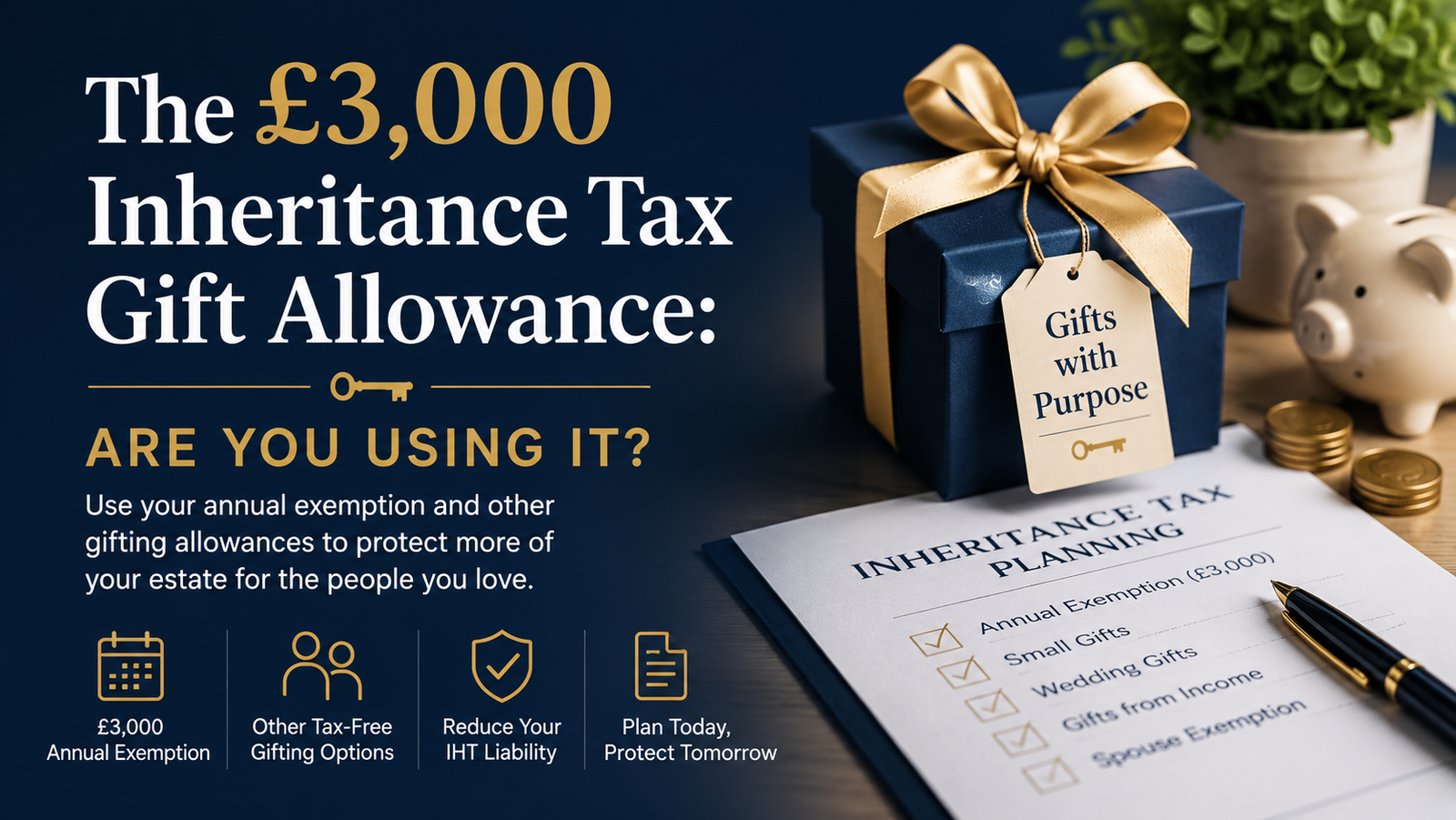
You can give away up to £3,000 each tax year using the Inheritance Tax annual exemption. These gifts are immediately exempt from Inheritance Tax and do not require you to survive for seven years.
If you did not use your annual exemption in the previous tax year, you can also carry the unused amount forward — but only for one tax year.
That makes the £3,000 allowance one of the simplest gifting exemptions available. But it is frequently misunderstood, and it is only one of several ways gifts can potentially be made without creating an Inheritance Tax liability.
What Is the £3,000 Inheritance Tax Gift Allowance?
Each tax year, you have an annual exemption of £3,000 for Inheritance Tax purposes.
This means you can give away assets or money with a total value of up to £3,000 during the tax year and those gifts will not be added to the value of your estate for Inheritance Tax purposes.
The £3,000 exemption applies to the person making the gifts, rather than separately to each recipient.
For example, you could:
- give £3,000 to one child;
- give £1,500 to each of two children;
- give £1,000 to three grandchildren; or
- divide the £3,000 between several people.
Provided the total gifts using the annual exemption do not exceed the available allowance, they can fall within the exemption.
Can You Carry Forward an Unused £3,000 Gift Allowance?
Yes, but only for one tax year.
If you did not use all of your annual exemption in the previous tax year, the unused amount can be carried forward into the current tax year.
This means that, in some circumstances, you could have up to £6,000 of annual exemptions available in one tax year.
However, you must use the current year’s annual exemption before using the amount carried forward from the previous year.
You cannot continue accumulating unused £3,000 exemptions over several years.
For example, if you made no qualifying gifts for five years, you would not suddenly have £15,000 of accumulated annual exemptions available.
Does the £3,000 Gift Allowance Mean You Cannot Give Away More?
No.
This is one of the most important distinctions to understand.
The £3,000 annual exemption is not a maximum limit on how much money you are allowed to give away.
You can give away considerably more than £3,000 if you wish.
The question is whether the gift is immediately exempt from Inheritance Tax, falls within another exemption, or remains relevant to your estate under the gifting rules.
Many larger outright gifts to individuals are treated as potentially exempt transfers. In simple terms, if the donor survives for seven years after making the gift, the gift will generally fall outside their estate for Inheritance Tax purposes.
This is the origin of the commonly discussed seven-year rule.
What Other Gifts Can Be Exempt From Inheritance Tax?
The £3,000 annual exemption is only one part of the gifting rules.
There are several other exemptions that may apply depending on the circumstances.
Small Gifts of Up to £250
You can make gifts of up to £250 per person per tax year to as many people as you wish, provided you have not used another allowance on the same person.
This is known as the small gift allowance.
For example, gifts to several grandchildren may potentially qualify separately for this exemption if the relevant conditions are satisfied.
Wedding and Civil Partnership Gifts
There are also specific exemptions for gifts made for a wedding or civil partnership.
The amount depends on your relationship to the person receiving the gift.
- £5,000 if the gift is to your child;
- £2,500 if the gift is to your grandchild or great-grandchild; and
- £1,000 if the gift is to another person.
These exemptions can potentially be used alongside the annual exemption, subject to the relevant rules.
Gifts Between Spouses and Civil Partners
Gifts between spouses or civil partners can generally be exempt from Inheritance Tax where the relevant conditions are satisfied.
This can make transfers between spouses or civil partners very different from gifts made to children, grandchildren or other beneficiaries.
Can You Give Away Regular Income Without the Seven-Year Rule?
Potentially, yes.
This is one of the most interesting areas of the Inheritance Tax gifting rules and one that families sometimes overlook.
Certain gifts may qualify as normal expenditure out of income.
Where the conditions are satisfied, qualifying gifts can be exempt from Inheritance Tax without requiring the donor to survive for seven years.
Broadly, the gifts need to form part of your normal expenditure, be made from income and leave you with enough income to maintain your normal standard of living.
This could potentially be relevant to someone whose regular income exceeds what they need to fund their lifestyle.
However, the conditions matter. Simply transferring a large amount of money and describing it as a gift out of income does not automatically make it exempt.
Why Is Keeping Records of Gifts Important?
If you make gifts as part of your estate planning, keeping accurate records can be extremely important.
After your death, your executors may need to establish what gifts were made, when they were made, who received them and which exemption was being used.
Useful records can include:
- the date of each gift;
- the recipient;
- the amount or value;
- the type of asset gifted;
- which exemption was intended to apply; and
- supporting information where gifts are being made regularly from income.
This becomes particularly important where gifting has taken place over many years.
A strategy may make perfect sense during your lifetime, but if nobody can demonstrate what happened later, administering the estate can become considerably more difficult.
Can a Couple Give Away £6,000 a Year?
Potentially, yes.
The annual exemption is an individual exemption.
Therefore, where two individuals each have their full £3,000 annual exemption available, they could potentially make gifts totalling £6,000 between them using their respective annual exemptions.
If both also had their full unused exemption available from the previous tax year, the combined amount potentially covered by the annual exemptions could be greater still.
The important point is to identify who is actually making each gift and what exemption that individual has available.
Should You Give Money Away Just to Reduce Inheritance Tax?
Not necessarily.
Reducing the size of your estate can reduce future Inheritance Tax exposure, but that does not automatically make gifting the right decision.
You also need to consider your own financial security.
Before making substantial gifts, questions worth considering include:
- How much income will you need during retirement?
- Could your expenditure increase later?
- Do you have sufficient emergency capital?
- Could you need money for care or other unexpected costs?
- Are you comfortable permanently losing control of the money?
- What happens if the recipient’s circumstances change?
Once an outright gift has genuinely been made, you should not assume that you can simply ask for the asset back later.
Inheritance Tax planning therefore needs to consider your own lifetime requirements as well as what you eventually want to leave to your family.
What If You Give Away Your House but Continue Living There?
Giving an asset away does not necessarily mean it has disappeared from your estate for Inheritance Tax purposes.
A classic example is giving your home to your children but continuing to live in it without paying an appropriate market rent.
The gift with reservation of benefit rules can mean that an asset you have technically given away is still treated as part of your estate if you continue to benefit from it.
This is why gifting property is very different from simply transferring £3,000 of cash under the annual exemption.
Is the £3,000 Gift Allowance Enough for Inheritance Tax Planning?
For a larger estate, the £3,000 annual exemption alone is unlikely to solve a substantial Inheritance Tax problem.
Consider an estate potentially facing an Inheritance Tax liability of several hundred thousand pounds.
Using the annual exemption can still be worthwhile, particularly when it forms part of a consistent long-term approach, but it needs to be considered in context.
Your overall estate may include:
- property;
- pensions;
- investments;
- cash;
- business interests;
- previous lifetime gifts; and
- other assets.
Each can have different tax and estate planning considerations.
The bigger question is therefore not simply:
“Am I using my £3,000 allowance?”
It is:
“How does gifting fit into the wider plan for my estate?”
The £3,000 Inheritance Tax Gift Allowance: The Key Point
The £3,000 annual exemption allows you to make gifts that are immediately exempt from Inheritance Tax, and an unused exemption can be carried forward for one tax year.
But £3,000 is not the maximum amount you can give away.
Other exemptions may apply, including small gifts, wedding or civil partnership gifts, transfers between spouses or civil partners and qualifying regular gifts made from income.
Larger gifts can also have different Inheritance Tax consequences depending on the circumstances and how long you survive after making them.
For that reason, gifting should be considered as one component of a wider estate plan rather than as a standalone tax strategy.
Explore More Estate Planning Insights
Inheritance Tax is only one part of estate planning.
Estate Architect Insights brings together practical information to help you understand how Inheritance Tax, pensions, property, gifting and wider estate planning can affect you and your family.
You can explore our latest articles alongside our Inheritance Tax video series, specialist reports and guides, estate planning briefings and educational resources.