
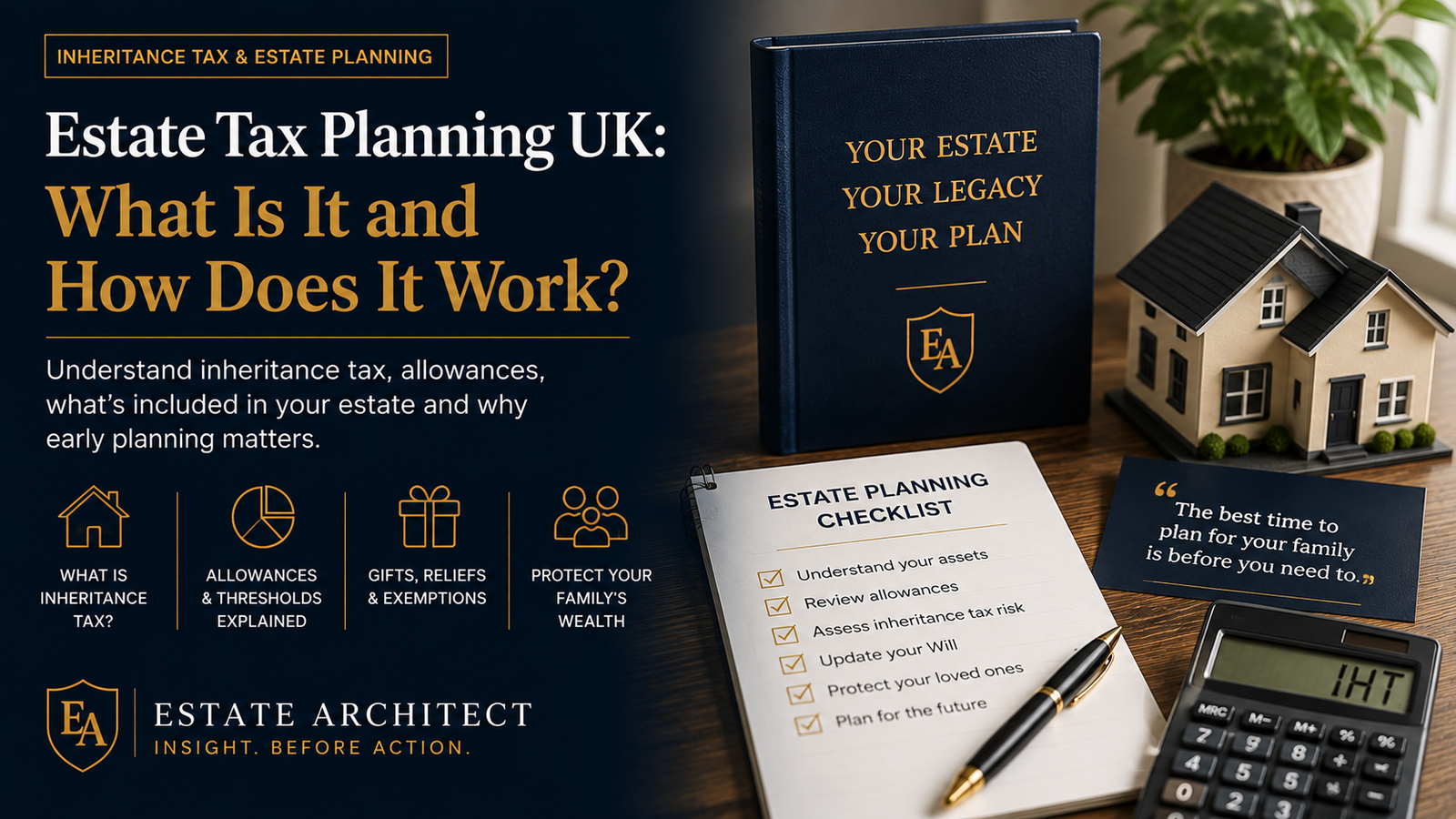
Estate tax planning in the UK normally refers to planning for Inheritance Tax (IHT) — the tax that may become payable on your estate when you die.
Although people often search online for “estate tax planning”, “tax estate planning” or “estate tax”, the UK tax is officially called Inheritance Tax.
For families with property, pensions, investments, businesses and other assets, estate tax planning is about understanding what could eventually be taxable, what allowances or exemptions may apply and whether action should be considered before it is too late.
What Is Estate Tax Planning in the UK?
Estate tax planning is the process of examining your assets and estimating the potential tax consequences when wealth eventually passes to your family or other beneficiaries.
Your estate can include assets such as:
- your home and other property;
- cash and savings;
- investments;
- business interests;
- personal possessions; and
- certain gifts or other assets that may need to be included when calculating your estate.
The objective is not simply to calculate an inheritance tax bill. Effective estate planning looks at how the different parts of your estate interact and identifies potential weaknesses before they become difficult or impossible to address.
Is Estate Tax the Same as Inheritance Tax in the UK?
When discussing UK estate planning, the tax most people are referring to as “estate tax” is Inheritance Tax (IHT).
Inheritance Tax is generally calculated by looking at the value of the estate, deducting relevant liabilities and then considering the exemptions, reliefs and tax-free thresholds that may be available.
The standard rate of Inheritance Tax is currently 40% on the taxable part of an estate above the available thresholds.
However, this does not mean that every estate above £325,000 automatically pays 40% tax. The eventual position depends on factors including who inherits the assets, the available allowances and whether any exemptions or reliefs apply.
What Is the Inheritance Tax Threshold?
The standard Inheritance Tax nil-rate band is currently £325,000.
There is also a residence nil-rate band of up to £175,000 where qualifying conditions are met, including leaving a qualifying home to direct descendants.
This means an individual may potentially have allowances of up to £500,000 in appropriate circumstances.
For married couples and civil partners, unused qualifying allowances can potentially be transferred to the surviving spouse or civil partner, meaning some couples may ultimately have combined thresholds of up to £1 million.
However, the residence nil-rate band has additional rules and can be reduced for larger estates, so the headline £1 million figure should not be assumed to apply to every family.
Why Can a £2 Million Estate Create an Additional Inheritance Tax Problem?
The residence nil-rate band begins to taper away when an estate exceeds £2 million.
This can create an important planning issue for families whose estate is close to or above that level.
As the estate grows, the family may not simply face inheritance tax on the additional wealth. They may also begin losing an allowance that they previously expected to receive.
This is why understanding the value of the whole estate can be more important than looking at individual assets separately.
What Assets Should You Include in Estate Tax Planning?
A useful starting point is to build a complete picture of your wealth.
This might include:
- your main residence;
- buy-to-let or other property;
- bank accounts and cash;
- ISAs and investment portfolios;
- shares and business interests;
- valuable personal possessions;
- trust interests where relevant;
- lifetime gifts that may still be relevant for inheritance tax; and
- pension arrangements and death benefits where relevant to the rules applying at the time.
You should also consider liabilities, ownership structures and whether assets are owned individually or jointly.
Without this overall picture, it can be difficult to understand the family’s true inheritance tax exposure.
How Does Your Home Affect Estate Tax Planning?
For many UK families, their home is one of the largest assets in their estate.
If a qualifying home passes to children or grandchildren, the residence nil-rate band may provide an additional inheritance tax allowance.
But property planning is not as simple as transferring the house to your children during your lifetime.
Giving away a property while continuing to live in it can potentially fall within the gift with reservation rules, meaning the property may still be treated as part of your estate for inheritance tax purposes.
Property ownership, gifting and estate planning therefore need to be considered together rather than in isolation.
How Do Lifetime Gifts Affect Inheritance Tax?
Giving assets away during your lifetime can form part of estate planning, but different rules apply to different types of gifts.
Some gifts are immediately exempt. Others may remain relevant for inheritance tax for a period after they are made.
For many outright gifts to individuals, the commonly discussed seven-year rule can be important. If the donor survives for seven years after making a qualifying gift, it will generally no longer be considered for inheritance tax purposes.
There are also specific exemptions and allowances, and accurate records of gifts can become extremely important when an estate is eventually administered.
Why Is Estate Tax Planning More Than Just Giving Money Away?
One of the biggest mistakes is treating inheritance tax planning as simply a question of reducing the size of your estate.
You still need enough assets and income to support your own lifestyle.
A strategy that reduces inheritance tax but leaves you without sufficient access to capital may create a much bigger problem.
Estate planning therefore needs to balance several objectives:
- reducing unnecessary inheritance tax exposure;
- maintaining your own financial security;
- protecting assets where appropriate;
- ensuring sufficient liquidity;
- making your wishes clear;
- keeping beneficiary arrangements up to date; and
- making the eventual administration of your estate easier for your family.
When Should You Start Estate Tax Planning?
Estate planning is generally more flexible when it begins before there is an immediate problem.
Some inheritance tax strategies involve time periods that cannot simply be recreated later. Gifts, ownership structures, pensions, business assets and other arrangements can also have tax, legal and financial consequences that need to be considered carefully.
Waiting until someone is very elderly or seriously ill can significantly reduce the options available.
That does not mean everyone should immediately restructure their estate. It means understanding your position early gives you more time to decide whether any action is appropriate.
How Do You Start Estate Tax Planning?
The first step should usually be understanding where you currently stand.
This means establishing:
- the approximate value of your estate;
- how your assets are owned;
- your potential inheritance tax exposure;
- which allowances and exemptions may be available;
- whether any allowances could be lost;
- how previous gifts may affect the position;
- how your Will and beneficiary arrangements interact with your assets; and
- where the main vulnerabilities in the estate may exist.
Only once the current position is understood does it become possible to assess which planning options may be worth exploring.
Estate Tax Planning UK: The Key Point
Estate tax planning in the UK is ultimately about understanding and planning for Inheritance Tax before wealth passes to the next generation.
It is not simply about finding a way to avoid tax.
Property, investments, pensions, businesses, gifts, Wills and family arrangements can all interact. Looking at only one asset can therefore leave significant weaknesses elsewhere in the estate.
The earlier those weaknesses are identified, the more time you generally have to decide what — if anything — should be done about them.
How Exposed Is Your Estate?
Estate Architect helps families assess their estate across property, pensions, investments, inheritance tax and family arrangements to identify potential weaknesses before implementation decisions are made.
If you do not know your likely inheritance tax exposure or whether your current arrangements work together, the first step is to establish where you stand.