
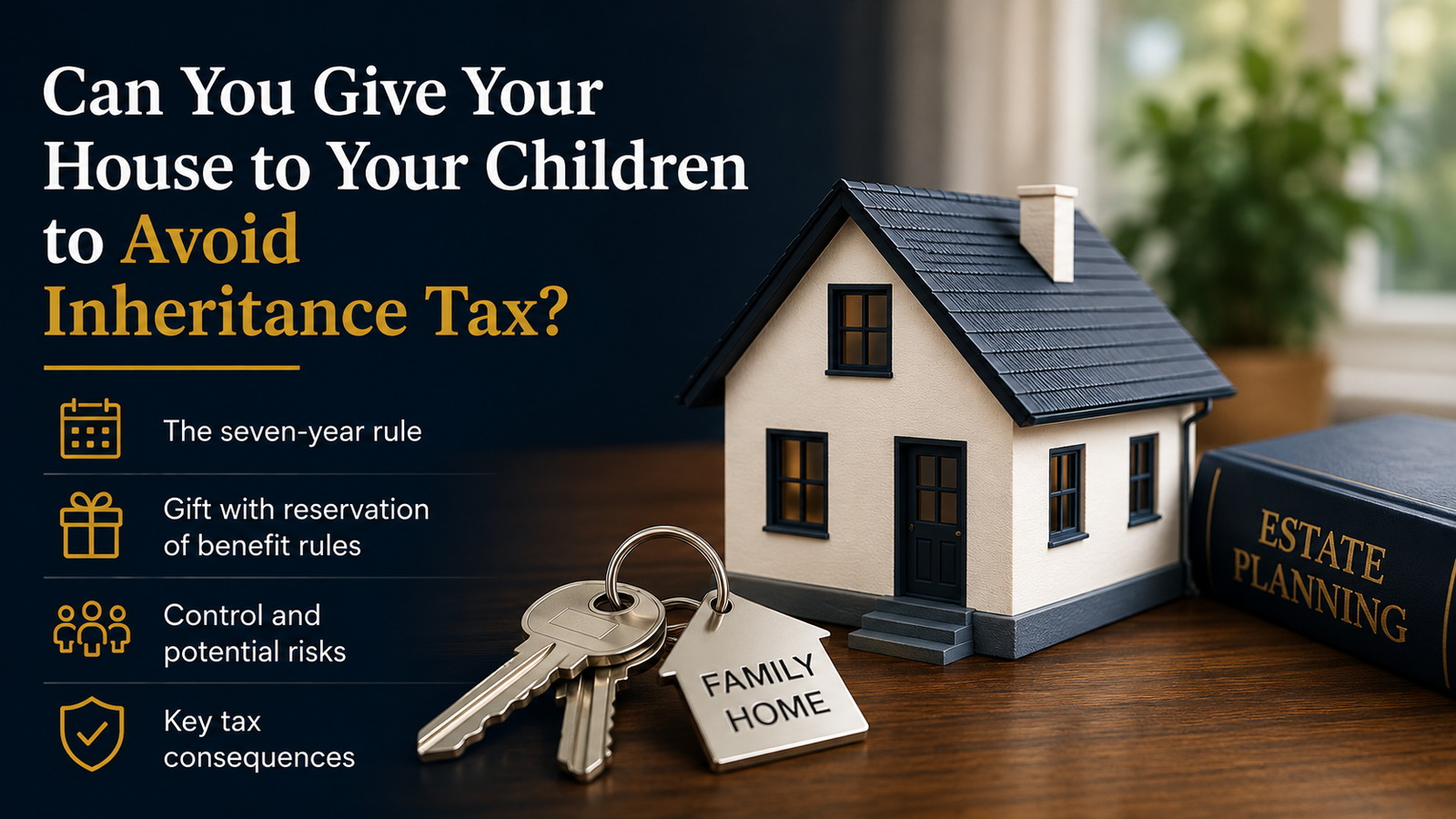
For many families, the home is the largest asset in the estate.
So when inheritance tax becomes a concern, one of the first questions people often ask is:
“Can I simply give my house to my children?”
It sounds straightforward. Transfer the property now, survive for seven years, and it will no longer form part of the estate for inheritance tax.
Unfortunately, it is not necessarily that simple.
Giving away a property while continuing to live in it can create significant inheritance tax, legal and financial complications.
Does the Seven-Year Rule Apply to Property?
Potentially, yes.
A genuine gift to an individual can potentially fall outside your estate for inheritance tax purposes if you survive for seven years after making the gift.
This is commonly known as the seven-year rule.
But transferring legal ownership alone is not necessarily enough.
If you continue benefiting from the asset after giving it away, different rules can apply.
This is particularly important with the family home.
What Is a Gift With Reservation of Benefit?
Imagine you own a house worth £800,000.
You transfer ownership to your children but continue living there exactly as you did before.
You don’t pay them a commercial rent and effectively continue treating the property as your own home.
HMRC may regard this as a Gift With Reservation of Benefit, often shortened to GWR or GROB.
In simple terms, you have technically given the asset away but have continued receiving the benefit of it.
As a result, the property may still be treated as part of your estate for inheritance tax purposes when you die.
This can remain the case even if you survive for considerably longer than seven years.
What If You Pay Rent to Your Children?
There can be circumstances where someone gives away a property and subsequently pays a full market rent to continue living there.
However, this is very different from simply transferring the title deeds.
There may be income tax consequences for the children receiving the rent, and the arrangement needs to be genuine and properly documented.
The financial implications also need careful consideration.
Giving away a valuable property purely to reduce inheritance tax should not leave you financially vulnerable later in life.
You Are Also Giving Away Control
Inheritance tax is only one consideration.
Once you genuinely give your home to your children, it is no longer your asset.
That distinction matters.
Your children’s circumstances can change.
They could divorce.
They could experience financial difficulties.
They could become bankrupt.
They could die before you.
Family relationships can also change over time.
An asset that was previously entirely under your control may therefore become exposed to circumstances outside your control.
This is why estate planning should consider asset protection and control, not simply the potential inheritance tax saving.
What About Capital Gains Tax?
Inheritance tax is not the only tax that needs considering when transferring property.
A gift is generally treated as a disposal for Capital Gains Tax purposes.
Whether CGT actually arises depends on the property and the individual’s circumstances.
For a qualifying main residence, Private Residence Relief may potentially reduce or eliminate a gain, whereas second homes, investment properties and buy-to-let properties can produce a very different result.
There may also be other tax and legal consequences depending on how ownership is transferred.
This is why changing property ownership should be assessed in the context of the whole estate, rather than looking at inheritance tax in isolation.
Could You Lose the Residence Nil Rate Band?
Property also interacts with another important inheritance tax allowance.
The Residence Nil Rate Band can potentially provide an additional allowance when a qualifying residence passes to direct descendants.
It is currently worth up to £175,000 per person, subject to the relevant conditions.
For married couples and civil partners, transferable allowances can potentially make this particularly valuable.
But the Residence Nil Rate Band also begins to taper away where the estate exceeds £2 million.
Before giving away a property, it is therefore important to understand whether doing so could affect allowances that might otherwise have been available.
What If the Property Continues Increasing in Value?
Another reason property deserves early attention is growth.
A house worth £700,000 today could be worth considerably more in ten or twenty years.
That growth can increase the size of the estate and potentially the inheritance tax liability.
For families already approaching important inheritance tax thresholds, property appreciation can gradually turn what appears to be a manageable position today into a much larger future liability.
Estate planning should therefore consider both:
What is the property worth today?
and
What could it reasonably be worth when the estate eventually passes to the next generation?
Should You Give Your House to Your Children?
There isn’t a universal answer.
For some families, lifetime gifting may form part of a wider estate-planning strategy.
For others, giving away the family home may create more problems than it solves.
Before transferring property, it is worth understanding:
whether you intend to continue living there;
whether the Gift With Reservation rules could apply;
how much control you are giving up;
the financial position of the recipients;
potential Capital Gains Tax consequences;
your future income and housing requirements;
the effect on your inheritance tax allowances; and
how the property fits with the rest of your estate.
The objective shouldn’t simply be to remove an asset from your estate.
It should be to understand what you gain, what you give up and what new risks you create by changing the ownership.
Start With the Whole Estate
Property planning should rarely be undertaken in isolation.
Your home needs to be considered alongside your pensions, investments, cash, Will, family circumstances and other assets.
A strategy that appears to save inheritance tax in one area can sometimes create an unintended problem somewhere else.
Before giving away one of your most valuable assets, understand the complete picture.
Good estate planning isn’t simply about giving assets away. It’s about deciding how wealth should be owned, protected and eventually transferred.
How Exposed Is Your Estate?
Understanding the issue is the first step. Estate Architect helps you identify potential weaknesses across your inheritance tax, pensions, property and wider estate — and understand what may deserve closer attention.
Start by finding out where your estate stands today.