
Before looking for ways to reduce Inheritance Tax, you first need to understand what problem you are actually trying to solve.
That sounds obvious, but estate planning can quickly become focused on individual solutions — gifting, trusts, pensions, property or life insurance — before anyone has established how much Inheritance Tax the estate may face or where its real vulnerabilities are.
Good Inheritance Tax planning should therefore begin with an assessment of the whole estate.
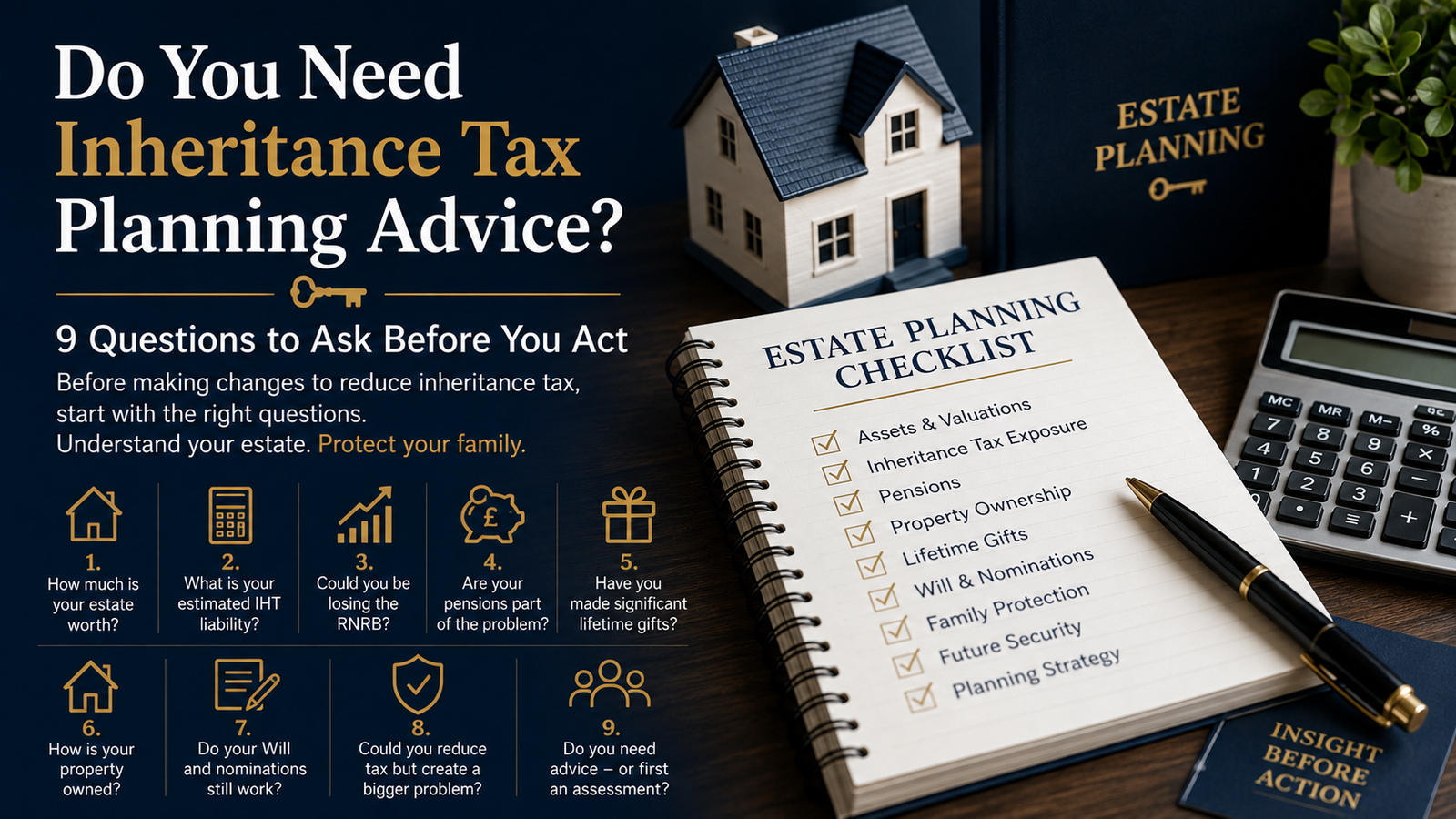
If you are considering taking action, these nine questions can help you identify what deserves closer attention before implementation decisions are made.
1. How Much Is Your Estate Actually Worth?
The first question is also one of the most important.
What would your estate be worth if you died today?
For many families, the answer is larger than expected because they think primarily about their home and savings rather than their complete financial position.
Your estate may include:
- your main residence;
- other property;
- cash and bank accounts;
- ISAs and investments;
- shares and business interests;
- valuable personal possessions;
- certain lifetime gifts; and
- other assets that may need to be considered for Inheritance Tax purposes.
Pensions also need increasing attention because the Government plans significant changes to the Inheritance Tax treatment of most unused pension funds and death benefits from 6 April 2027.
Without establishing the approximate value of the whole estate, it is difficult to understand the scale of the potential problem.
2. What Is Your Estimated Inheritance Tax Liability?
Once you understand the approximate value of the estate, the next question is:
How much Inheritance Tax could actually become payable?
The standard Inheritance Tax nil-rate band is currently £325,000.
A further residence nil-rate band of up to £175,000 may also be available where the relevant conditions are satisfied, including where a qualifying home is left to direct descendants.
Transfers between spouses or civil partners can also affect the eventual position, and unused qualifying allowances may potentially be transferred to the surviving spouse or civil partner.
The standard Inheritance Tax rate is generally 40% on the taxable part of the estate above the available thresholds.
But simply applying 40% to everything above £325,000 can produce a misleading answer.
You need to understand which allowances, exemptions and reliefs may actually apply to your circumstances.
3. Could You Be Losing the Residence Nil-Rate Band?
Families with larger estates need to consider another potential problem.
The residence nil-rate band begins to reduce where the value of an estate exceeds £2 million.
It is tapered by £1 for every £2 that the estate exceeds the £2 million threshold.
This means a growing estate can create two problems at the same time:
- there is more wealth potentially exposed to Inheritance Tax; and
- an additional tax-free allowance may begin to disappear.
This can be particularly relevant where rising property values, investments and other assets have gradually pushed an estate above £2 million.
Someone who assumes they have the full residence nil-rate band available may therefore discover that their actual position is very different.
4. Are Your Pensions Part of the Problem?
Pensions have historically been treated differently from many other estate assets for Inheritance Tax purposes.
That is one reason some families have deliberately preserved pension wealth while spending other assets during retirement.
However, the Government plans to bring most unused pension funds and death benefits within the scope of Inheritance Tax from 6 April 2027.
For someone with a substantial defined contribution pension, this could materially change their estate planning position.
It is therefore important to establish:
- what pension arrangements you have;
- their approximate value;
- who is currently nominated to receive the benefits;
- how the scheme’s death benefits operate;
- how much of the pension you may need during your lifetime; and
- how the planned April 2027 changes could affect the wider estate.
The answer is not automatically to withdraw money from a pension.
Taking money out can create different tax and estate consequences, so the pension needs to be considered alongside the rest of your financial position.
5. Have You Already Made Significant Lifetime Gifts?
Inheritance Tax planning should also consider what has already happened, not simply what you intend to do next.
If you have previously given substantial amounts of money or assets to children, grandchildren or other beneficiaries, those gifts may still be relevant when calculating your estate.
Important information includes:
- what was given;
- when the gift was made;
- who received it;
- the value at the time of the gift; and
- whether an exemption applied.
Some outright lifetime gifts may fall outside the estate if the donor survives for seven years, while other gifts can qualify for specific exemptions.
Good record-keeping is therefore extremely important.
Your executors should not have to reconstruct years of gifting history after your death with incomplete bank statements and family recollections.
6. How Is Your Property Owned?
For many UK families, property represents the largest part of the estate.
But knowing the value of your home is not enough.
You also need to understand how the property is legally owned and what happens to it on death.
For jointly owned property, the distinction between joint tenants and tenants in common can affect how ownership passes when one person dies.
Property planning can become even more important for:
- unmarried couples;
- blended families;
- second marriages;
- families with children from previous relationships;
- buy-to-let owners; and
- people considering gifting property during their lifetime.
Simply transferring your home to your children is not necessarily an Inheritance Tax solution either. If you continue benefiting from an asset after giving it away, the gift with reservation rules may become relevant.
7. Do Your Will and Beneficiary Nominations Still Work?
Having a Will does not automatically mean that every part of your estate will pass exactly as you expect.
Different assets can pass under different arrangements.
Pension death benefits, jointly owned property, trusts and other arrangements may not necessarily be controlled simply by the instructions in your Will.
That makes it important to review your estate as a connected system.
Questions worth asking include:
- When was your Will last updated?
- Have you married or divorced since it was written?
- Have children or grandchildren been born?
- Are your pension beneficiary nominations current?
- Are the people named as executors still appropriate?
- Have any beneficiaries died or experienced major changes in circumstances?
- Does the ownership of your assets still match what your Will is intended to achieve?
A document can be legally valid while the wider estate plan is still outdated.
8. Could You Reduce Tax but Create a Bigger Financial Problem?
This is one of the most important questions in Inheritance Tax planning.
Reducing tax should not come at the expense of your own financial security.
For example, giving substantial assets away may reduce the value of your estate, but you also need to consider whether you could need that money later.
Your future requirements might include:
- retirement income;
- holidays and lifestyle expenditure;
- helping family members;
- home improvements;
- unexpected emergencies;
- health or care costs; and
- general protection against inflation and longevity.
The same principle applies to pensions, investments and property.
A strategy that appears efficient from an Inheritance Tax perspective may be inappropriate if it compromises your lifestyle, creates unnecessary risk or leaves you without sufficient access to capital.
Estate planning therefore needs to balance tax efficiency with lifetime financial security.
9. Do You Need Advice — or Do You First Need a Proper Assessment?
People often begin by asking:
“What should I do to reduce my Inheritance Tax?”
But that may be the wrong first question.
Before deciding what to implement, you need to know:
- what your estate is worth;
- your estimated tax exposure;
- which allowances may be available;
- which allowances you could be losing;
- where the vulnerabilities are;
- which assets are creating the greatest exposure;
- what you need to retain for your own lifetime; and
- which areas require specialist tax, legal or regulated financial advice.
Only after establishing those facts can different planning options be properly considered.
This is the difference between starting with a solution and starting with a diagnosis.
What Should Inheritance Tax Planning Advice Consider?
Inheritance Tax rarely exists as an isolated problem.
Your tax position can interact with your property, pensions, investments, business interests, family arrangements, lifetime gifts and retirement requirements.
That means good planning should not simply answer:
“How can I pay less Inheritance Tax?”
It should also consider:
“What needs to happen for my estate to work properly for me during my lifetime and for my family afterwards?”
Sometimes that may involve tax planning. Sometimes it may reveal weaknesses in ownership, documentation, beneficiary arrangements, liquidity or family governance that are just as important.
Inheritance Tax Planning Advice: The Key Point
Before implementing an Inheritance Tax strategy, establish exactly where you stand.
Calculate the approximate estate, understand the potential tax exposure, identify the allowances that may apply and determine where the biggest vulnerabilities exist.
Only then should individual planning options be assessed.
Inheritance Tax planning is rarely about finding one product, one trust or one clever tax strategy.
It is about understanding how the different parts of your estate work together — and identifying where they do not.
How Exposed Is Your Estate?
Estate Architect’s starting point is to understand the estate before deciding what, if anything, should be implemented.
Our Estate Vulnerability Review looks across areas including Inheritance Tax, property, pensions, investments and family arrangements to help identify potential weaknesses in the existing estate.
If you do not yet know your likely Inheritance Tax exposure or where the main vulnerabilities in your estate may be, establishing your current position is the logical first step.