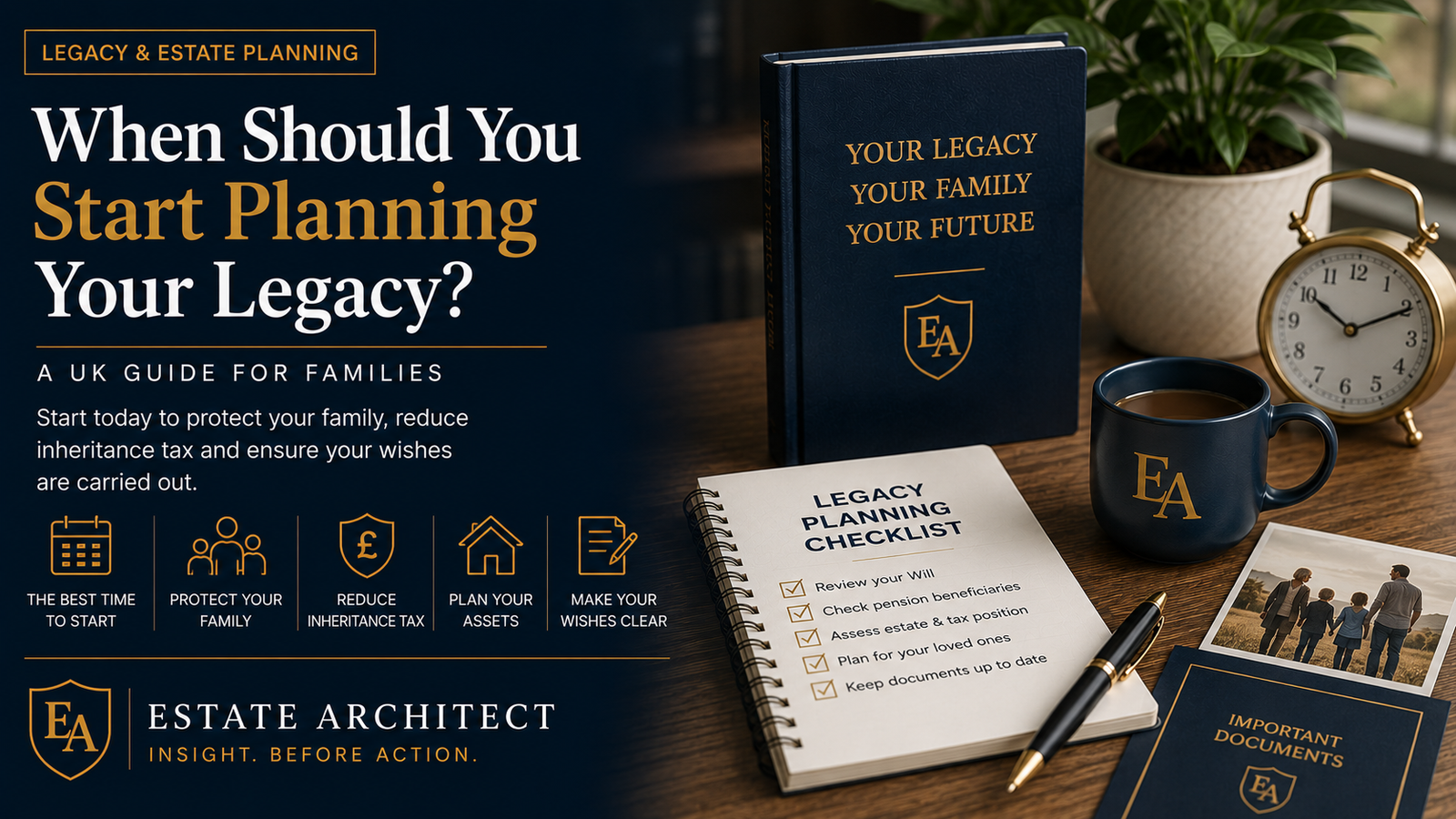
You do not need to wait until later life to start planning your legacy. In fact, many of the most important estate planning decisions are easier to make while you are healthy, financially independent and have time to consider your options.
Legacy planning is not simply about deciding who receives your assets when you die. It can involve your Will, property, pensions, investments, lifetime gifts, beneficiary arrangements, inheritance tax and the practical information your family may eventually need.
The right time to start will depend on your circumstances, but there are several points in life when reviewing your estate becomes particularly important.
What Does Planning Your Legacy Actually Mean?
Planning your legacy means deciding how you want your wealth and responsibilities to be managed both during your lifetime and eventually passed to the people you care about.
For many families, that means considering several areas together:
- your Will;
- property ownership;
- pensions and beneficiary nominations;
- savings and investments;
- lifetime gifts;
- inheritance tax;
- Lasting Powers of Attorney;
- business interests;
- executors and other important appointments; and
- the records and information your family may eventually need.
Having a Will is an important part of this, but a Will alone does not necessarily mean that the rest of your estate is properly organised.
When Should You Start Planning Your Legacy?
The best time to start is generally before you believe you urgently need to.
You do not necessarily need complex planning at a particular age. What matters more is whether you have accumulated assets, have people who depend on you or have clear wishes about what should eventually happen to your wealth.
There are also certain events that should prompt you to review your arrangements.
When You Buy a Property
For many people, buying a home is the first time they acquire a substantial asset.
How property is owned can affect what happens to it on death, particularly where a property is owned jointly.
If you subsequently marry, divorce, remarry or have children, the way that property fits into your estate may need to be reconsidered.
When You Have Children
Having children changes estate planning significantly.
You may need to consider guardianship, who should manage assets for younger beneficiaries and at what age children should eventually receive an inheritance.
As children become adults, those decisions may need to change again.
When You Get Married or Divorced
Marriage, civil partnership, separation and divorce can materially change your estate planning position.
Existing Wills, property ownership, pension nominations and beneficiary arrangements should therefore be reviewed following major changes in a relationship.
Blended families can create additional complexity because the interests of a surviving spouse or partner may need to be balanced against the eventual inheritance of children from previous relationships.
When Your Estate Becomes More Valuable
Many estates become significantly larger without the owner deliberately doing anything.
Property values may rise, investments may grow, pensions may accumulate and businesses may become more valuable.
An estate that once had little or no potential inheritance tax exposure can therefore develop a substantial liability over time.
Regularly estimating the value of your overall estate can help identify when tax planning deserves greater attention.
Should You Wait Until Retirement to Start Estate Planning?
There is no requirement to wait until retirement.
Retirement can certainly be a useful point to conduct a comprehensive estate review because your income, pension arrangements and financial priorities may be changing.
But waiting until retirement simply because estate planning feels like something for older people can mean missing years in which relatively straightforward decisions could have been made.
Some estate planning strategies also depend on time. Starting earlier can therefore provide greater flexibility than trying to make every decision much later.
Why Does Time Matter for Inheritance Tax Planning?
Some inheritance tax rules make timing particularly important.
For example, certain lifetime gifts may remain relevant to an estate for inheritance tax purposes for a number of years after they are made.
The commonly discussed seven-year rule means that waiting until very late in life before considering gifting can reduce the practical value of some planning opportunities.
There may also be exemptions for particular types of gifts, so the tax treatment should be understood before assuming that every gift works in the same way.
Why Should Pension Planning Form Part of Your Legacy?
Pensions can represent one of the largest assets a family has accumulated, yet they are sometimes reviewed separately from the rest of the estate.
Beneficiary nominations should be kept up to date, and families should understand what their particular pension arrangements provide on death.
This is becoming increasingly important because the Government plans significant changes to the inheritance tax treatment of most unused pension funds and death benefits from 6 April 2027.
If pensions represent a substantial part of your wealth, they should therefore be considered alongside property, investments and the rest of your estate rather than treated as an entirely separate issue.
What Happens If You Leave Estate Planning Too Late?
Leaving planning until very late does not necessarily mean that nothing can be done.
But your options may become more limited.
There may be less time for lifetime planning, family discussions, changes to ownership arrangements or other measures that require careful implementation.
Health and mental capacity can also become relevant. Some decisions that are straightforward while you have full capacity can become considerably more complicated if capacity is subsequently lost.
This is one reason Lasting Powers of Attorney can be an important part of wider estate planning rather than something considered only in an emergency.
How Often Should You Review Your Estate Plan?
Estate planning should not necessarily be treated as a one-time exercise.
Your circumstances can change, and so can tax legislation.
A review may be appropriate following significant events such as:
- marriage or civil partnership;
- divorce or separation;
- the birth of children or grandchildren;
- buying or selling a property;
- receiving an inheritance;
- retirement;
- selling a business;
- a substantial increase in your wealth;
- the death of a spouse, beneficiary or executor; or
- significant changes to tax or pension legislation.
Even without a major event, periodically checking whether your arrangements still reflect your circumstances can identify problems that would otherwise remain unnoticed.
What Should You Review When Planning Your Legacy?
A useful starting point is to establish exactly what you own, how it is structured and what would happen if you died today.
Questions worth considering include:
- Is your Will current?
- Do you know the approximate value of your estate?
- Do you know your potential inheritance tax exposure?
- How is your property owned?
- Are your pension beneficiary nominations current?
- Have lifetime gifts been properly recorded?
- Do you have appropriate Lasting Powers of Attorney?
- Do your executors know where important documents and assets can be found?
- Have major changes in your family been reflected in your arrangements?
- Does everything work together as one estate plan?
Answering those questions can often reveal where further investigation is needed.
When Should You Start Planning Your Legacy? The Key Point
Legacy planning is generally most effective when it begins before there is an urgent reason to do it.
You do not need to implement complicated arrangements simply because you own assets. But understanding your position early gives you time to identify weaknesses, consider the available options and make decisions without unnecessary pressure.
Your estate will also continue to change throughout your lifetime.
The objective is therefore not simply to create an estate plan once. It is to make sure that your Will, property, pensions, investments, family arrangements and tax position continue to work together as your circumstances evolve.
How Exposed Is Your Estate?
Estate Architect helps families identify potential weaknesses across inheritance tax, property, pensions, investments and wider estate arrangements before implementation decisions are made.
If you are unsure whether your current arrangements would work as intended, understanding where you stand is the first step.