
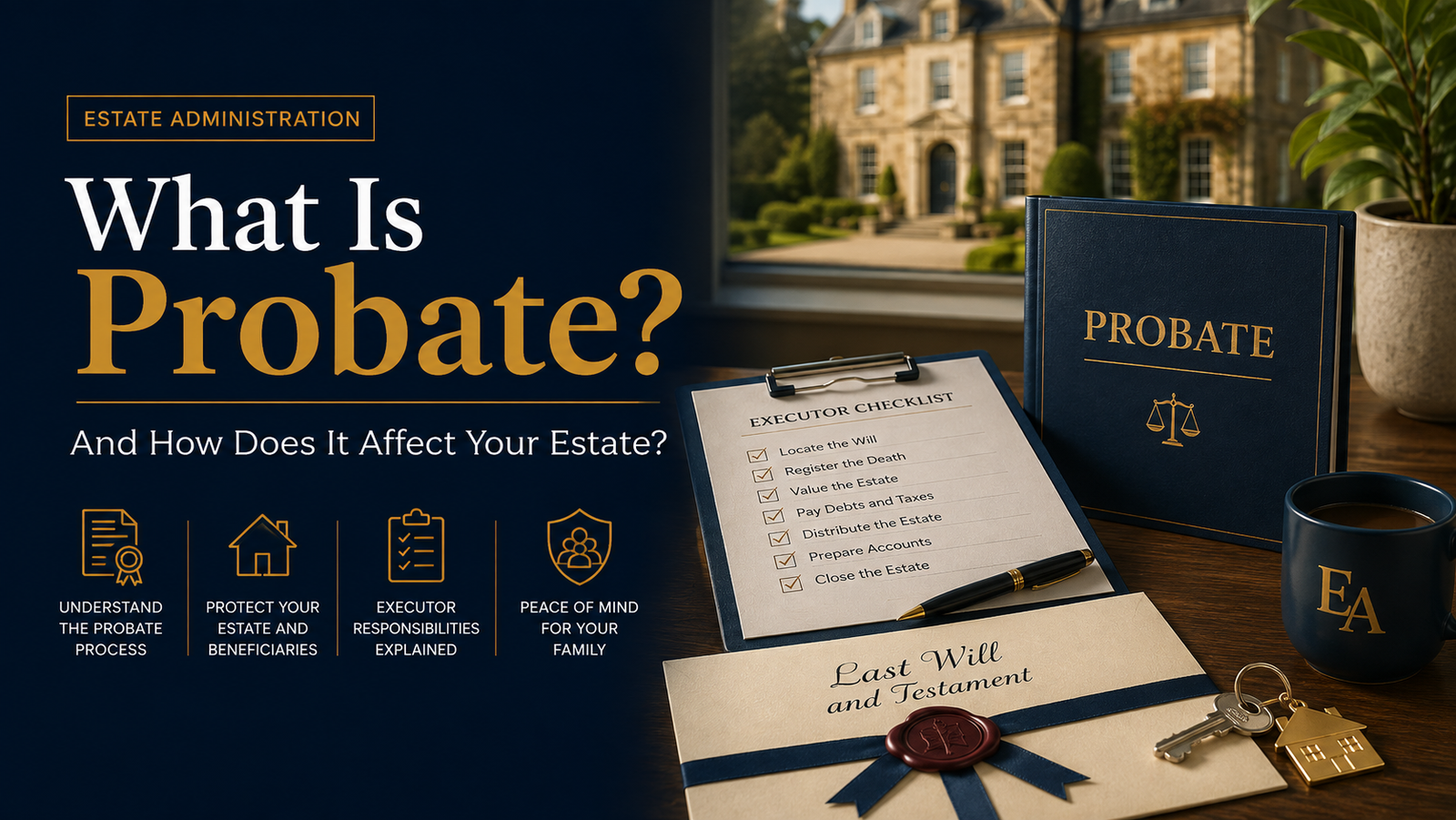
When someone dies, their family may already be dealing with property, pensions, investments, bank accounts and inheritance tax.
But there is another process that can determine how quickly those assets can actually be dealt with: probate.
Probate is often treated as something that only needs to be considered after death. In reality, understanding how probate works can be an important part of estate planning because the structure and organisation of an estate during your lifetime can have a significant impact on what your executors and family have to deal with later.
What Is Probate?
Probate is the legal process through which a deceased person’s estate is administered.
Where there is a valid Will, the executors named in the Will will normally apply for a Grant of Probate.
Where someone dies without a valid Will, different rules apply and an appropriate person may need to apply for Letters of Administration.
The grant gives the people administering the estate the legal authority they may need to deal with assets such as property, bank accounts and investments.
However, probate is only one part of the wider estate administration process.
Executors may also need to identify assets and liabilities, obtain valuations, establish whether inheritance tax is due, settle debts and eventually distribute the estate to the beneficiaries.
Why Probate Matters in Estate Planning
A Will is important, but having a Will does not necessarily mean an estate will be simple to administer.
Consider an estate containing:
a family home;
several bank and investment accounts;
pension arrangements;
lifetime gifts;
business interests;
trusts;
overseas assets; and
digital or less obvious assets.
The executors first need to establish what exists, where it is held, how it is owned and what documentation supports it.
That is why good estate planning is not simply about deciding who inherits.
It is also about making the estate understandable and manageable for the people who will eventually administer it.
Does Every Estate Need Probate?
Not necessarily.
Whether a grant is required can depend on the assets within the estate and how they are owned.
For example, some jointly owned assets may pass automatically to the surviving owner, while institutions may have their own requirements for releasing money held in the deceased person’s sole name.
This means two estates of a similar value can potentially be very different to administer.
The structure of the assets matters, not simply the total value of the estate.
What Happens to Property?
Property can be particularly important.
How a property is owned can affect what happens following a death.
For example, jointly owned property may be held as joint tenants or tenants in common. These forms of ownership can have different consequences for how a deceased person’s interest passes.
Property may also represent a substantial proportion of the estate while providing very little immediate cash.
That can become important if the estate has taxes, debts or other expenses to meet.
What About Inheritance Tax?
Probate and inheritance tax are separate issues, but they can interact.
Executors need to establish the value of the estate and determine the inheritance tax position.
Depending on the circumstances, inheritance tax may need to be dealt with before the estate can be fully administered.
This can create a practical issue where an estate is valuable on paper but does not contain enough readily accessible cash.
For example, much of the wealth might be tied up in:
property;
private businesses;
investments; or
other illiquid assets.
This is why estate liquidity can be just as important as the headline inheritance tax calculation.
Good Records Can Make a Significant Difference
Imagine being appointed executor but not knowing:
which banks the deceased used;
where investments are held;
whether significant gifts were made;
what pension arrangements exist;
where the latest Will is stored;
whether trusts exist; or
which professional advisers were involved.
The family may eventually discover everything, but unnecessary detective work can make estate administration considerably more difficult.
Maintaining organised and current estate records can therefore be an important part of planning.
Probate Is About More Than the Will
One of the common misconceptions about estate planning is:
“I have a Will, so everything is sorted.”
A Will is an important document, but it does not by itself organise the underlying estate.
A more complete review considers how the different elements fit together:
Property → Pensions → Investments → Gifts → Ownership → Will → Executors → Liquidity → Records
Weakness in one area can create problems elsewhere.
Questions Worth Asking About Your Own Estate
A useful estate review might therefore ask:
Do your executors know what you own?
Could they locate the important documents?
Is ownership of your property clearly understood?
Are records of lifetime gifts being maintained?
Are pension nominations and other arrangements current?
Could the estate meet potential taxes and expenses without forcing assets to be sold at an unsuitable time?
Would your family understand what needs to happen if you were no longer there to explain it?
These questions go beyond simply writing a Will.
They consider whether the estate could actually be administered effectively.
The Bigger Estate Planning Picture
Probate happens after death.
But many of the issues that make probate difficult are created years earlier.
Poor records, unclear ownership, outdated documents and disconnected arrangements can all make an estate harder for executors and beneficiaries to understand.
That is why estate planning should consider not only:
“Who will inherit my wealth?”
but also:
“How straightforward will it be for my family to deal with everything when the time comes?”
Review Your Estate Before It Needs to Be Administered
Estate Architect looks at how the different parts of an estate work together — including property, pensions, investments, inheritance tax exposure, estate documentation and family arrangements.
A review can help identify potential weaknesses or gaps before they become an issue for the people who eventually have to administer your estate.
Book a Consultation with Ranjeet →
Estate Architect provides educational research and analysis relating to inheritance tax and estate planning concepts for UK residents. We do not provide regulated investment, tax or legal advice and are not authorised or regulated by the Financial Conduct Authority (FCA). Where regulated advice is required, introductions may be made to authorised professionals.