
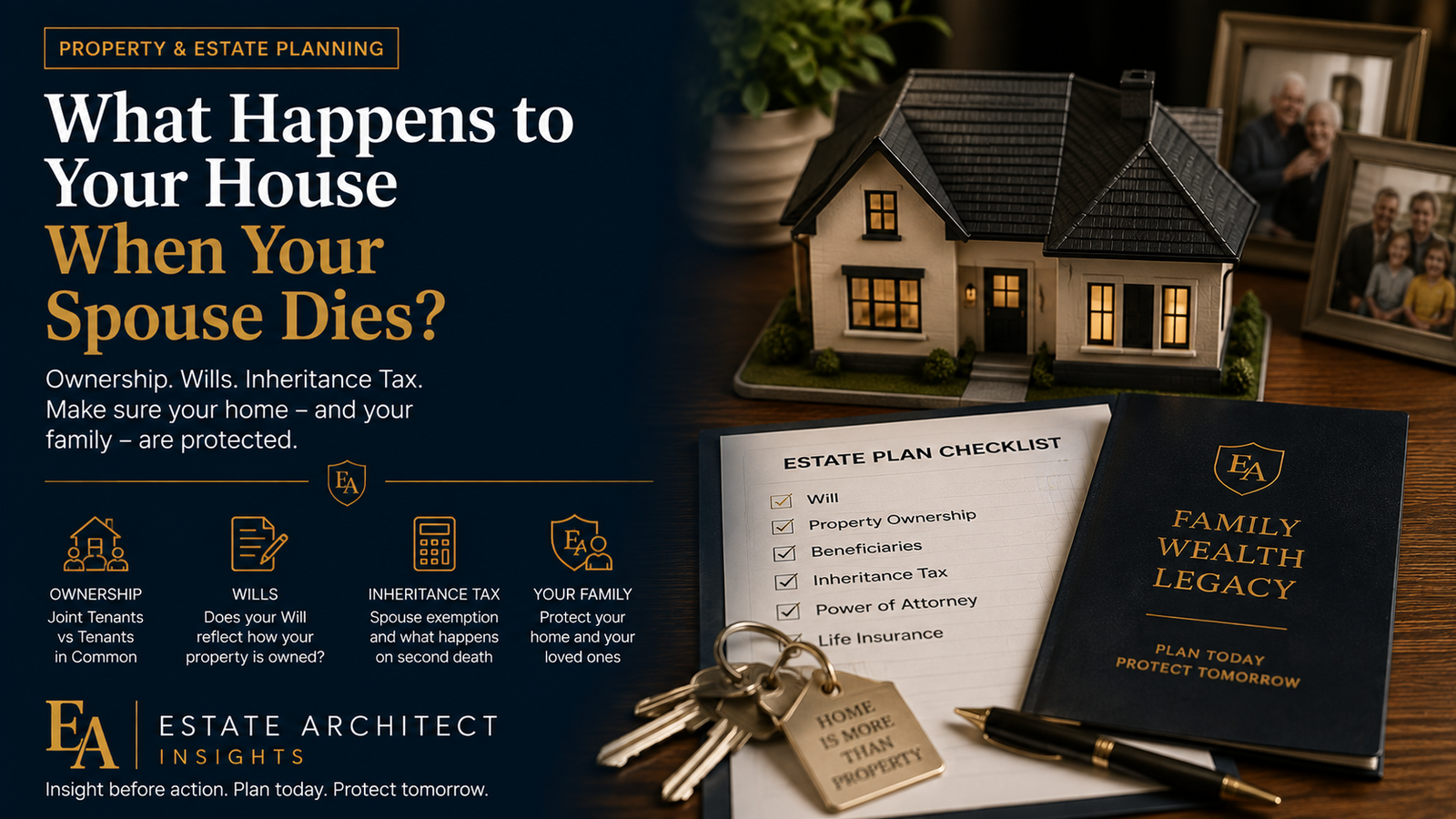
For many families, the family home is their largest asset.
Yet surprisingly few people know exactly what happens to the property when one spouse or civil partner dies.
Does the surviving spouse automatically inherit the house?
Does the Will determine who receives it?
Could inheritance tax be payable?
The answer depends partly on how the property is owned and what wider estate planning arrangements are in place.
How Is Your Property Owned?
For couples who own a property together, there are two common forms of ownership:
Joint Tenants and Tenants in Common.
The distinction becomes particularly important when one owner dies.
What Happens If You Own the House as Joint Tenants?
If you own your home as Joint Tenants, both owners effectively own the property together rather than owning separately identifiable shares.
When one owner dies, their interest in the property normally passes automatically to the surviving joint owner through the right of survivorship.
This happens outside the terms of the Will.
So even if the deceased person’s Will says something different about their share of the property, the Joint Tenancy will generally determine what happens to the home.
The surviving spouse then becomes the sole owner.
What Happens If You Are Tenants in Common?
Tenants in Common works differently.
Each person owns a defined share of the property.
That might be:
50% / 50%
but it does not necessarily have to be equal.
When one owner dies, their share does not automatically pass to the surviving owner.
Instead, their share can pass according to their Will or, if there is no valid Will, under the intestacy rules.
This can provide considerably more flexibility for estate planning.
Does Your Spouse Pay Inheritance Tax on the House?
Transfers between spouses and civil partners are generally covered by the spouse exemption for inheritance tax, subject to certain rules including circumstances involving a non-UK domiciled spouse.
Therefore, where the home passes to a surviving spouse or civil partner, there will often be no immediate inheritance tax charge on that transfer.
However, that does not mean inheritance tax has disappeared.
It may simply have been deferred until the second death.
What Happens on the Second Death?
This is where the value of the property can become particularly important.
Suppose a married couple owns a home worth £1 million.
On the first death, the property passes to the surviving spouse.
There may be no inheritance tax payable at that stage because of the spouse exemption.
But the surviving spouse now owns the entire £1 million property.
If the property increases in value and forms part of their estate when they eventually die, its full value may need to be considered when calculating the inheritance tax position.
The estate may potentially benefit from the Nil Rate Band and Residence Nil Rate Band, including unused allowances transferred from the first spouse where the relevant conditions are satisfied.
But the final tax position depends on the size and structure of the entire estate.
What About the Residence Nil Rate Band?
The Residence Nil Rate Band can potentially provide an additional inheritance tax allowance when a qualifying residence passes to direct descendants.
However, there are conditions.
It is also subject to tapering for estates worth more than £2 million.
For larger estates, this can become particularly significant because the Residence Nil Rate Band may gradually be lost as the value of the estate increases.
Property values therefore need to be considered alongside pensions, investments, cash and other assets rather than in isolation.
Does Your Will Control What Happens to the House?
It depends on the ownership structure.
With Joint Tenants, the right of survivorship will normally determine what happens on the first death.
With Tenants in Common, your Will can generally determine what happens to your share.
This is one reason why reviewing your Will without checking how your property is legally owned can leave an estate plan incomplete.
The two need to work together.
What If There Is Still a Mortgage?
A mortgage does not disappear when someone dies.
The lender still has security over the property, and the outstanding debt will need to be dealt with.
Depending on the circumstances, the surviving spouse may continue the mortgage, refinance it, repay it using other estate assets or potentially use proceeds from life insurance.
This is another reason why estate planning should consider liquidity as well as asset ownership.
Owning a valuable property does not necessarily mean an estate has enough readily available cash.
What If You Are Not Married?
This is particularly important.
Unmarried partners do not receive the same inheritance tax treatment as married couples and civil partners.
There is no general spouse exemption simply because two people have lived together for many years.
The way the property is owned, the Will and the wider estate arrangements can therefore have very different consequences for unmarried couples.
Assuming that a long-term partner will automatically receive the same treatment as a spouse can create serious problems.
Property Ownership Should Match Your Estate Plan
There is no single ownership structure that is automatically right for every family.
Joint Tenancy may provide simplicity and automatic succession.
Tenants in Common may provide greater flexibility over how each person’s share passes.
The appropriate structure depends on factors including:
- your family circumstances,
- who you ultimately want to inherit,
- the value of your estate,
- your Will,
- inheritance tax considerations,
- and what should happen after the first and second deaths.
The important thing is that the ownership of the property and the estate plan are working together.
Do You Know What Would Happen to Your Home?
Your property may be one of the most valuable assets in your estate, but the way it is owned can affect what happens after the first and second deaths.
Estate Architect can help you understand how your property ownership, Will, inheritance tax position and wider estate arrangements fit together.