
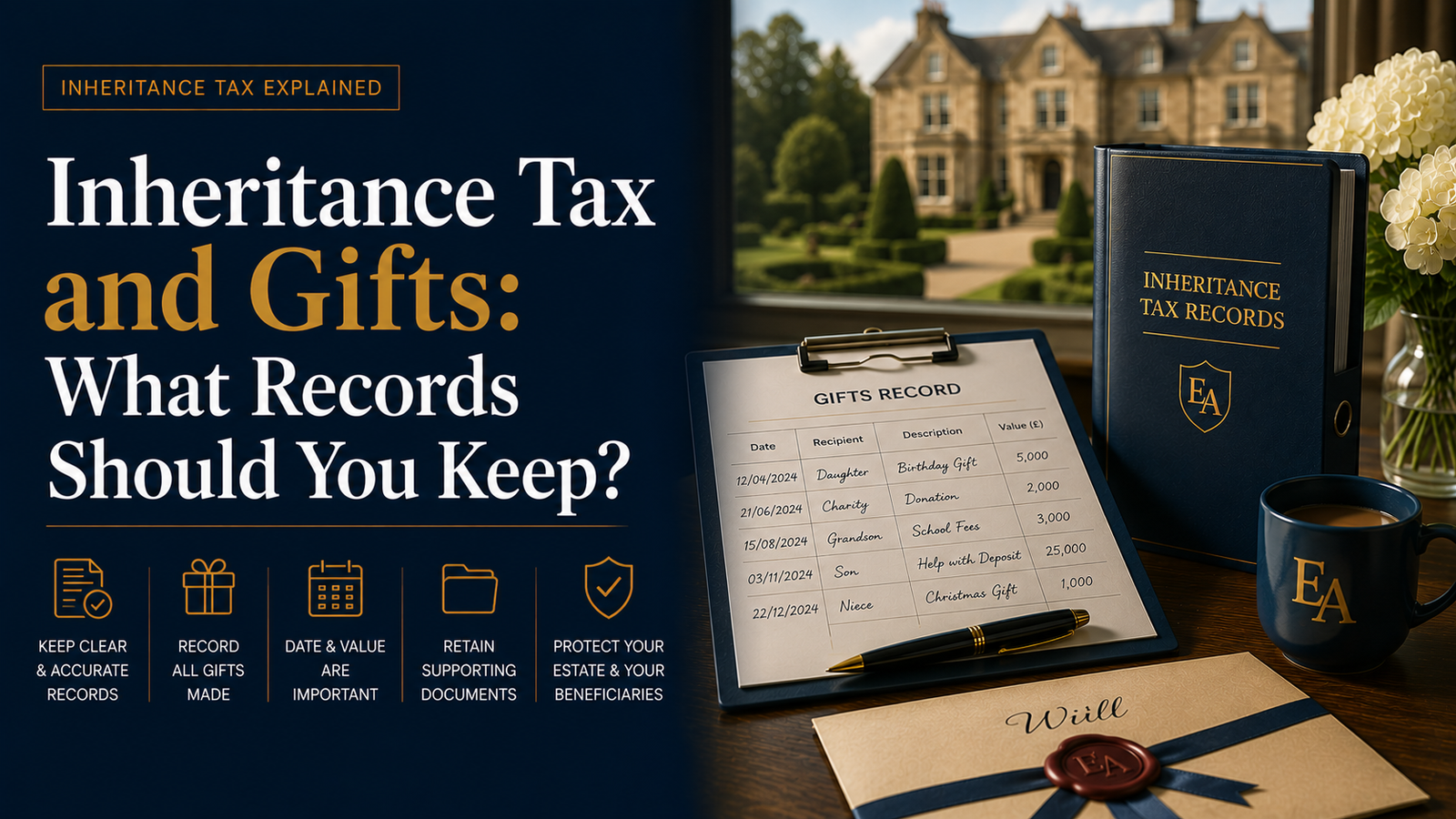
Giving money or assets to children, grandchildren or other family members can be a perfectly normal part of managing family wealth.
But years later, those gifts can become important when an estate is being administered.
One of the problems executors can face is surprisingly simple:
Nobody can prove exactly what was given, when it was given or why.
Good record-keeping does not make a gift exempt from inheritance tax. But it can make it much easier to establish the correct inheritance tax position when the time comes.
Why Do Records of Lifetime Gifts Matter?
When someone dies, their executors may need to establish whether gifts made during the person’s lifetime are relevant to the inheritance tax calculation.
That can mean looking back over several years.
If the deceased maintained clear records, the process may be relatively straightforward.
If they did not, executors could be left examining old bank statements, transfers and financial records trying to reconstruct what happened.
A payment of £20,000, for example, might have been:
- A gift to a child
- A loan
- Payment for something
- A transfer between accounts
- Part of normal expenditure
- A gift potentially covered by an exemption
Without supporting records, the context may not be obvious.
How Far Back Could Executors Need to Look?
The seven-year rule is one of the best-known concepts in inheritance tax planning.
Broadly, certain lifetime gifts can remain relevant for inheritance tax purposes if the person making the gift dies within seven years.
But this does not mean that every gift automatically becomes completely irrelevant after seven years, or that all gifts are treated in exactly the same way.
Different rules can apply depending on the nature of the gift and the circumstances.
The practical lesson is much simpler:
Keep proper records rather than relying on your family to remember what happened years later.
What Information Should You Record?
For significant gifts, a useful record could include:
Date of the gift
When was the money or asset transferred?
Recipient
Who received it?
Amount or value
How much was given, or what was the approximate value of the asset at the time?
Nature of the gift
Was it cash, property, shares or another asset?
Reason or exemption being relied upon
Was the gift intended to fall within a particular inheritance tax exemption?
Supporting evidence
Are bank statements, transfer confirmations, correspondence or other documents available?
Keeping these details together can make the eventual estate administration considerably clearer.
What Is the £3,000 Annual Exemption?
Individuals can generally make gifts covered by an annual exemption of £3,000 each tax year.
If the previous year’s annual exemption was unused, it may generally be carried forward for one tax year.
But again, records matter.
Years later, executors may need to establish when gifts were made and which exemptions were potentially available.
A simple gift register can provide a much clearer audit trail.
What About Small Gifts?
There is also a small gifts exemption which can potentially apply to gifts of up to £250 per person in a tax year, subject to the relevant conditions.
Families may make numerous smaller gifts over time.
You do not necessarily need an elaborate filing system for every birthday present.
But where gifting becomes a deliberate part of estate planning, keeping an organised record becomes increasingly valuable.
Gifts for Weddings or Civil Partnerships
Certain gifts made on or shortly before a wedding or civil partnership can potentially qualify for specific exemptions.
The amount available depends on the relationship between the person making the gift and the recipient.
If you intend to rely on such an exemption, record:
- Who received the gift
- The date
- The amount
- The occasion
- Your relationship to the recipient
The principle remains the same:
If an exemption could matter later, keep evidence of why you believe it applied.
What About Regular Gifts From Income?
This is an area where record-keeping can become particularly important.
Certain gifts may potentially be exempt where they qualify as normal expenditure out of income, subject to the relevant conditions.
This is not simply a question of writing “gift from income” next to a bank transfer.
The circumstances matter.
It may be necessary to demonstrate things such as the pattern of gifting, the donor’s income and expenditure and whether the gifts affected their normal standard of living.
That means good records can be extremely useful.
Relevant information might include:
- Annual income
- Regular expenditure
- Amounts gifted
- Dates of gifts
- Recipients
- Evidence of an established pattern
Without records, demonstrating what happened several years earlier can become much harder.
What If You Give Away an Asset but Continue Using It?
Giving something away does not necessarily mean it has disappeared from your estate for inheritance tax purposes.
A classic example is giving your home to your children but continuing to live there without appropriate arrangements.
Rules concerning gifts with reservation of benefit can potentially mean that an asset remains relevant to the estate despite legal ownership having been transferred.
This illustrates why the documentation should record more than simply:
“House gifted to children.”
The arrangements surrounding the gift can matter too.
Keep Records of Loans Separately
Families frequently transfer money between generations without clearly deciding whether the payment is a gift or a loan.
That distinction can become important.
If you give your child £100,000, that may have different estate consequences from lending your child £100,000 which remains repayable to you.
The documentation should therefore make the intention clear.
If it is a loan, maintain an appropriate record of the loan and any repayments.
If it is a gift, record it as a gift.
Ambiguity creates unnecessary problems later.
Don’t Rely on Bank Statements Alone
Bank statements are useful evidence, but they may not tell the whole story.
Imagine an executor discovering a transfer from seven years earlier:
£50,000 — John Smith
Who is John Smith?
Why was £50,000 transferred?
Was it a gift?
A loan?
Payment for an asset?
Was an exemption relevant?
The transaction itself does not necessarily answer those questions.
A short contemporaneous record can provide the missing context.
Create a Lifetime Gift Register
For families making significant gifts, a Lifetime Gift Register can be a useful part of their estate records.
It does not need to be complicated.
A simple table could record:
| Date | Recipient | Gift | Value | Exemption/Reason | Evidence |
|---|---|---|---|---|---|
| 12 May 2025 | Daughter | Cash | £10,000 | Family gift | Bank statement |
| 3 Oct 2025 | Grandchild | Cash | £3,000 | Annual exemption | Transfer record |
The important thing is consistency.
Update the register when gifts are made rather than trying to reconstruct everything years later.
Make Sure Your Executors Can Find It
Creating excellent records is not much use if nobody knows they exist.
Your executors should be able to locate the important information needed to administer your estate.
That might include:
Will and estate documents
Asset register
Lifetime gift register
Property records
Trust documentation
Insurance information
Professional adviser details
You do not necessarily need to give executors unrestricted access to everything during your lifetime.
But there should be a clear way for the appropriate people to locate the information when it is eventually required.
Good Estate Planning Leaves an Audit Trail
Estate planning is often discussed in terms of tax strategies.
But administration matters too.
If you make substantial gifts over many years, the people eventually administering your estate may need to understand decisions that were made long before they became executors.
Clear records can make that considerably easier.
The question therefore isn’t simply:
“Have I made gifts?”
It is also:
“Could my executors prove what I did?”
Review Your Estate Records
Estate Architect looks at how the different elements of an estate fit together, including lifetime gifts, property, pensions, investments, inheritance tax exposure and estate documentation.
A structured review can help identify gaps in the records and arrangements your family may eventually need to rely upon.
Book a Consultation with Ranjeet →
Estate Architect provides educational research and analysis relating to inheritance tax and estate planning concepts for UK residents. We do not provide regulated investment, tax or legal advice and are not authorised or regulated by the Financial Conduct Authority (FCA). Where regulated advice is required, introductions may be made to authorised professionals.