
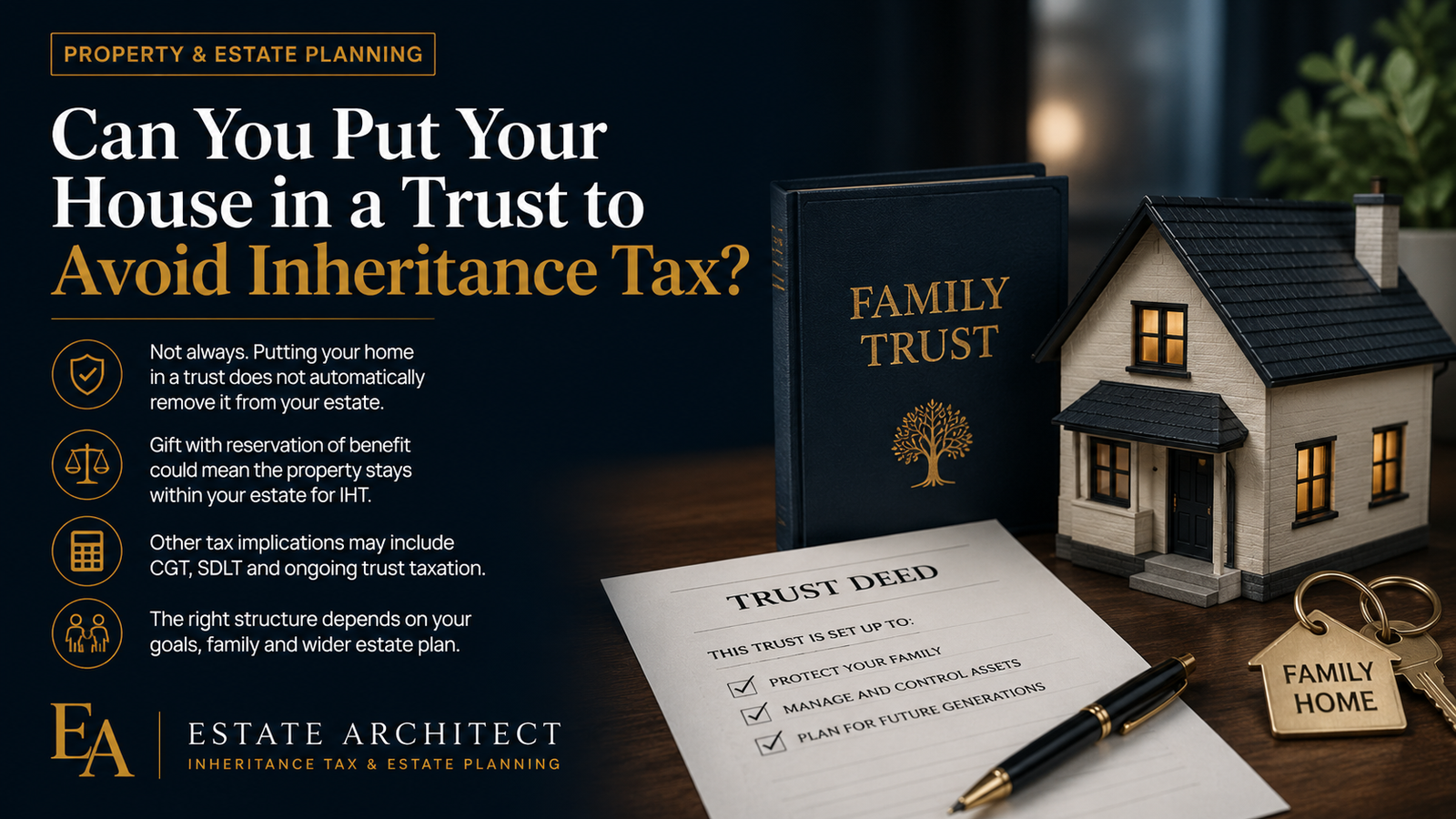
Putting your home into a trust is often presented as a simple way to protect property from inheritance tax.
Unfortunately, it is rarely that simple.
A trust can be a useful estate-planning structure in the right circumstances, but transferring your home into one does not automatically remove the property from your estate for inheritance tax purposes.
Why Do People Put Property Into Trust?
There are many legitimate reasons why a trust may form part of an estate plan.
It may be used to control how assets eventually pass to beneficiaries, protect assets for younger family members, provide for different generations, or deal with complicated family circumstances.
But the important question is not simply:
“Is my house in a trust?”
It is:
“What does the trust actually achieve?”
Different trusts can have very different tax and legal consequences.
Does Putting Your House in a Trust Avoid Inheritance Tax?
Not necessarily.
One of the biggest issues arises when someone transfers their home but continues to live there and enjoy the property much as they did before.
For inheritance tax purposes, simply changing the legal ownership may not be enough.
HMRC can potentially treat arrangements where someone gives away an asset but continues to benefit from it as a gift with reservation of benefit.
That can mean the property remains relevant to their estate for inheritance tax purposes despite having previously been transferred.
There Can Be Other Tax Consequences
Inheritance tax is also not the only consideration.
Depending upon the structure and circumstances, transferring property into trust can potentially have implications involving:
- Capital Gains Tax
- Stamp Duty Land Tax
- ongoing trust taxation
- reporting and administration
- control of the property
- future sale or refinancing
- beneficiaries and succession
This is why a trust should generally not be considered purely on the basis of whether it might reduce an inheritance tax bill.
The Bigger Question: What Are You Trying to Achieve?
Before changing ownership of your home, it is important to understand the objective.
Are you trying to reduce inheritance tax?
Protect children or grandchildren?
Control who ultimately inherits the property?
Plan for a blended family?
Protect a surviving spouse or partner?
Or simply make the estate easier to administer?
The appropriate structure can be very different depending upon the answer.
Property Should Be Considered as Part of the Whole Estate
For many families, their home is only one part of their wealth.
Pensions, investments, cash, businesses, life assurance and other property may all affect the eventual inheritance tax position.
Looking at the house in isolation can therefore produce a very different answer from looking at the estate as a whole.
The objective should not simply be to put assets into structures.
It should be to understand what you own, what risks exist, what you want to achieve and which planning options deserve further investigation.
Not Sure What This Means for Your Estate?
Every estate is different. Before changing how your property is owned or structured, it can help to understand how it fits into your wider inheritance tax position.