
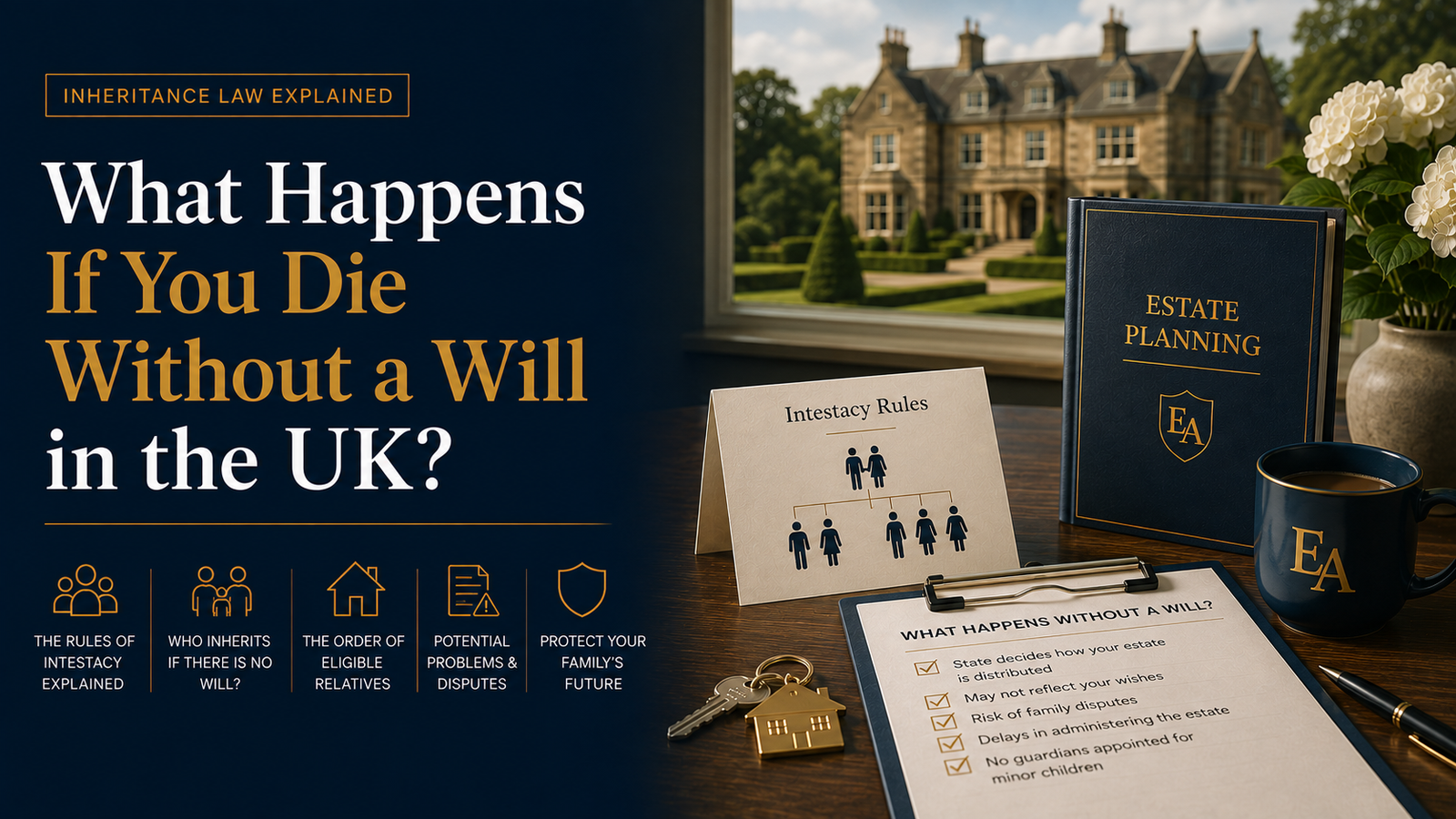
Many people assume that if they die without a Will, their family will simply decide between themselves how everything should be divided.
That is not how it works.
If you die without a valid Will in England and Wales, you are said to have died intestate, and your estate is distributed according to the rules of intestacy.
Those rules determine who can inherit — and they may produce a very different result from what you intended.
What Does Dying Intestate Mean?
A Will allows you to set out who should inherit your estate and who you want to administer it after your death.
Without a valid Will, there are no instructions from you.
Instead, the law determines who is entitled to inherit.
This can become particularly important where families include:
- Unmarried partners
- Children from previous relationships
- Stepchildren
- Separated spouses
- Second families
- Dependants
- Relatives you may not have intended to benefit
The more complicated the family structure, the more important it can be to understand what would actually happen.
Does Your Spouse Automatically Inherit Everything?
Not necessarily.
If you are married or in a civil partnership, your spouse or civil partner may inherit under the intestacy rules.
But whether they receive the entire estate can depend on whether you also leave children and on the value and composition of the estate.
This is one reason the assumption:
“I’m married, so everything automatically goes to my spouse.”
can be dangerous.
The actual outcome depends on the circumstances.
What Happens If You Have Children?
Children can potentially inherit under the intestacy rules.
Where a deceased person leaves both a spouse or civil partner and children, the estate may need to be divided according to the statutory rules rather than simply passing entirely to one person.
That may be very different from the arrangement the family expected.
It can also become more complicated where there are children from previous relationships.
What About an Unmarried Partner?
This is one of the biggest misconceptions.
Living together for many years does not automatically give an unmarried partner the same inheritance rights as a spouse or civil partner.
There is no general rule that says a long-term partner automatically inherits because they are a “common-law spouse”.
If you are not married or in a civil partnership, your partner may receive nothing automatically under the intestacy rules, regardless of how long you have lived together.
That can create serious problems where:
- The home is owned by one partner
- One person is financially dependent on the other
- There are children from previous relationships
- The couple assumed everything would simply pass to the survivor
Do Stepchildren Automatically Inherit?
Not necessarily.
The intestacy rules distinguish between particular family relationships.
A stepchild whom you may have treated as your own for decades does not automatically have the same position as a biological or legally adopted child under the intestacy rules.
For blended families, relying on intestacy can therefore produce particularly unexpected outcomes.
What Happens to Your House?
The answer depends partly on how the property is owned.
A jointly owned home can be held in different ways.
For example, property owned as joint tenants may pass differently from a share in property owned as tenants in common.
This means the Will — or absence of a Will — is only part of the picture.
Property ownership needs to work together with the wider estate plan.
Who Deals With the Estate If There Is No Will?
A Will normally names executors who are responsible for administering the estate.
Without a Will, there are no appointed executors.
Instead, someone entitled under the relevant rules may need to apply to become an administrator of the estate.
The authority obtained is generally known as Letters of Administration, rather than a Grant of Probate.
The administrator then has responsibility for dealing with the estate.
Does Dying Without a Will Avoid Probate?
No.
Not having a Will does not mean the estate avoids the legal administration process.
Depending on the assets involved, an appropriate person may still need to obtain legal authority before they can deal with property, bank accounts, investments and other assets.
In fact, the absence of a Will can potentially make matters more complicated because there are no executor appointments or written instructions from the deceased.
What About Inheritance Tax?
Dying without a Will does not remove inheritance tax.
The estate still needs to be valued and the inheritance tax position established.
But the way assets pass can matter because different inheritance tax exemptions and allowances can depend on who receives the assets and in what circumstances.
This is why a Will should not be considered completely separately from inheritance tax planning.
The different elements of the estate need to work together.
What Happens If You Have No Close Family?
The intestacy rules contain an order determining which relatives may inherit.
If no qualifying relatives can be found, the estate may ultimately pass to the Crown under the rules known as bona vacantia.
Again, the law decides.
Not the deceased person’s friends.
Not their informal wishes.
Not necessarily the people they were closest to.
A Will Does More Than Decide Who Gets the Money
A Will is often thought of simply as a document saying:
“I leave my assets to these people.”
But it can serve a much wider purpose.
Depending on the circumstances, a Will can help address:
- Who administers the estate
- Who inherits
- How assets are divided
- Arrangements involving children
- Blended-family considerations
- Certain trust arrangements
- Specific gifts
- Wishes concerning particular assets
It therefore forms an important part of the wider estate structure.
Having a Will Is Not the End of the Story
There is another mistake worth avoiding.
Having a Will does not necessarily mean you have the right Will today.
A Will written many years ago may no longer reflect:
- Your current family
- Your current wealth
- Your property ownership
- Your beneficiaries
- Your business interests
- Your wider estate-planning arrangements
Major changes in circumstances can therefore be a good reason to review whether the existing arrangements still reflect what you want.
Five Questions Worth Asking
Rather than simply asking “Do I have a Will?”, consider:
1. Is my Will still current?
2. Does it reflect my present family circumstances?
3. Does it work with the way my property is owned?
4. Are the people I want to benefit actually provided for?
5. Do my executors know where the Will and important estate records are held?
If you cannot confidently answer those questions, your estate arrangements may warrant a closer review.
Don’t Leave Your Estate Plan to the Default Rules
The rules of intestacy provide a legal framework for estates where someone dies without a valid Will.
But they cannot know your family, your relationships or your intentions.
A Will gives you the opportunity to document those intentions.
And a wider estate review can help establish whether the Will, property ownership, pensions, investments, inheritance tax position and other arrangements actually work together.
Review Your Estate Before Your Family Has To
Estate Architect examines the different elements of an estate to identify potential weaknesses, gaps and areas that may require further investigation.
The objective is to understand how your estate works while you are still able to make decisions about it.
Book a Consultation with Ranjeet →
Estate Architect provides educational research and analysis relating to inheritance tax and estate planning concepts for UK residents. We do not provide regulated investment, tax or legal advice and are not authorised or regulated by the Financial Conduct Authority (FCA). Where regulated advice is required, introductions may be made to authorised professionals.