
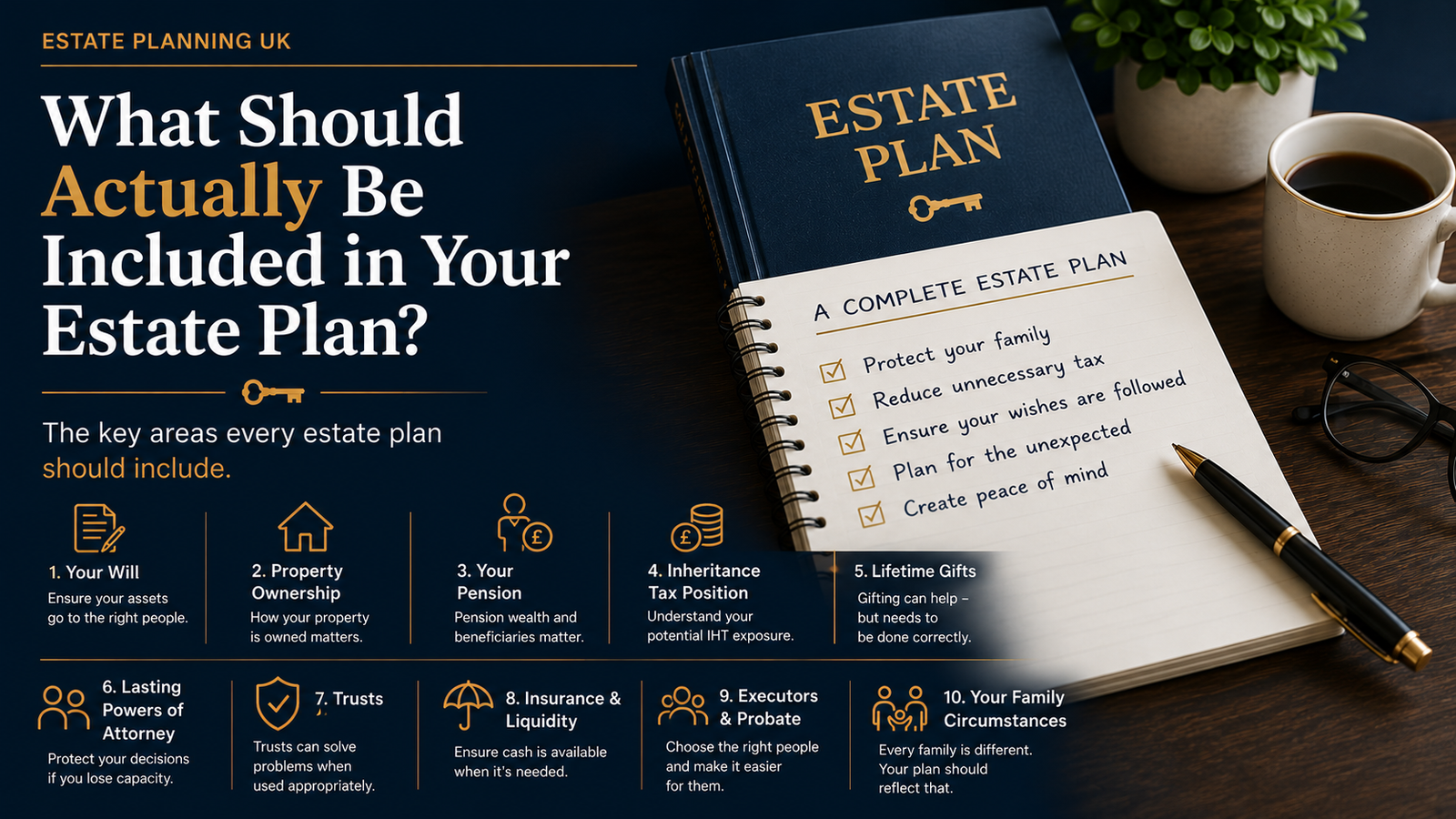
Estate planning in the UK is about far more than writing a Will.
A well-structured estate plan considers your property, pensions, investments, inheritance tax position, gifts, legal documents and family circumstances together. The objective is to understand what you own, what could happen to it during your lifetime and after your death, and whether your current arrangements are likely to produce the outcome you intend.
For families with significant property, pensions or investments, looking at each area separately can leave important gaps.
What Is Estate Planning in the UK?
Estate planning is the process of reviewing how your assets and financial arrangements are structured during your lifetime and how they may eventually pass to your beneficiaries.
An estate plan may consider:
- Property and how it is owned
- Pensions and death benefits
- Investments and savings
- Your Will
- Lasting Powers of Attorney
- Inheritance tax
- Lifetime gifts
- Trust arrangements
- Life insurance
- Executors and probate
- Business interests
- Family circumstances and intended beneficiaries
The important point is that these areas do not necessarily operate independently.
A change to one part of your estate can affect another. For example, gifting an asset may have tax consequences, changing property ownership can affect succession, and pension arrangements can influence the eventual value and tax exposure of an estate.
Is Estate Planning the Same as Inheritance Tax Planning?
No.
Inheritance tax planning is one part of estate planning.
For estates potentially exposed to inheritance tax, reducing unnecessary tax can be extremely important. But an estate plan should also consider whether assets will pass to the right people, whether sufficient liquidity will be available, who will manage the estate and whether your family understands your arrangements.
An estate could therefore have an inheritance tax strategy and still have weaknesses elsewhere.
Likewise, concentrating exclusively on a Will does not necessarily address pensions, tax, property ownership or lifetime financial arrangements.
What Should an Estate Plan Include?
There is no single estate plan that is appropriate for every family. However, there are several areas that are normally worth examining.
1. Your Will
Your Will establishes how assets covered by it should be distributed after your death and identifies who should administer your estate.
But simply having a Will does not mean your estate planning is complete.
It is worth checking:
When the Will was written
Whether your family circumstances have changed
Whether the executors remain appropriate
Whether the beneficiaries remain correct
Whether your assets have changed substantially
Whether the Will works alongside your other arrangements
A Will written many years ago may no longer reflect the estate you have today.
2. Property Ownership
For many UK families, the family home is the largest individual asset in the estate.
You should understand not only what the property is worth, but how it is legally owned.
For jointly owned property, the distinction between joint tenants and tenants in common can affect what happens when one owner dies.
Property planning may also need to consider mortgages, second properties, buy-to-let investments, overseas property and previous gifts or transfers.
This is why property should normally be reviewed as part of the wider estate rather than in isolation.
3. Your Pension
Pensions can represent a substantial proportion of family wealth.
They therefore need to be considered alongside the rest of an estate rather than simply viewed as retirement income.
This is particularly important because the Government plans to bring most unused pension funds and death benefits within the scope of inheritance tax from 6 April 2027.
For people with substantial pension assets, that can materially change future estate-planning calculations.
A pension review should therefore consider the type of pension, its value, beneficiary nominations, retirement requirements and how it interacts with the rest of the estate.
4. Your Inheritance Tax Position
A useful starting point is understanding approximately what your estate is worth today.
That may include:
Property
Cash
Investments
Business interests
Personal possessions
Relevant trust interests
Other assets
Pension wealth where relevant to future planning
You can then consider the inheritance tax allowances and exemptions potentially available.
The standard nil-rate band is currently £325,000.
A residence nil-rate band of up to £175,000 may also be available where qualifying conditions are satisfied. However, the residence nil-rate band begins to taper for estates worth more than £2 million.
Transfers between spouses and civil partners can also materially affect the eventual inheritance tax calculation.
The actual position depends upon individual circumstances, which is why headline estate values alone can be misleading.
5. Lifetime Gifts
Giving assets away during your lifetime can form part of an estate plan, but gifting needs to be properly understood and documented.
There are several inheritance tax exemptions that may apply to gifts.
For example, individuals currently have an annual exemption of £3,000, with the possibility of carrying forward unused exemption from the previous tax year in qualifying circumstances.
Other rules can apply to small gifts, wedding or civil partnership gifts and regular gifts made from surplus income.
Larger gifts may also fall under the potentially exempt transfer rules and the familiar seven-year period.
However, the seven-year rule is not the only consideration. The type of asset, continued use of the asset, affordability of the gift and other tax consequences can all matter.
Good estate planning therefore looks at the consequences of a gift before simply transferring an asset.
6. Lasting Powers of Attorney
Estate planning is not only about what happens after death.
You should also consider what would happen if you were alive but unable to manage your own affairs.
A Lasting Power of Attorney can allow nominated individuals to make certain decisions on your behalf.
There are two main types in England and Wales:
Property and Financial Affairs and Health and Welfare.
For families with complex financial arrangements, investments, businesses or property, this can be an important part of continuity planning.
7. Trusts
Trusts can be useful estate-planning structures in appropriate circumstances, but they should not automatically be viewed as a simple way to avoid inheritance tax.
Different trusts have different legal and tax consequences.
Before establishing one, it is important to understand:
- Why the trust is being created
- Which assets will enter it
- Who the trustees will be
- Who the beneficiaries are
- What access or control is required
- The potential tax consequences
- The administrative responsibilities
A trust should solve a defined planning problem rather than simply exist because somebody has been told that they “need a trust.”
8. Life Insurance and Estate Liquidity
An estate can be valuable on paper but still have relatively little available cash.
That can create problems where tax, debts, professional costs or other expenses need to be paid before assets can easily be distributed.
Property-rich estates are an obvious example.
Life insurance can sometimes form part of the solution, particularly where a predictable liability has been identified.
But ownership, beneficiaries and whether a policy is appropriately structured can affect how useful the proceeds ultimately are.
9. Executors and Probate
Who will actually deal with everything when you die?
Executors may have to identify assets, obtain valuations, deal with HMRC, apply for probate, settle liabilities and eventually distribute the estate.
For a simple estate this may be relatively straightforward.
For an estate containing multiple properties, substantial investments, businesses, trusts or complicated family arrangements, the administrative burden can be considerably greater.
An estate plan should therefore consider how easily somebody else could understand and administer your affairs.
10. Your Family Circumstances
Tax is important, but families are rarely as simple as a tax calculation.
An estate plan may need to consider:
- Children from previous relationships
- Unmarried partners
- Divorce or remarriage
- Financially dependent relatives
- Vulnerable beneficiaries
- Children or grandchildren
- Family businesses
- Unequal gifts made during your lifetime
Two families with identical £2 million estates could require very different planning.
That is why estate planning should begin with the family and objectives, not simply with a particular financial product or tax strategy.
Why Can Looking at Everything Separately Create Problems?
One of the biggest estate-planning weaknesses is fragmentation.
You may have a solicitor dealing with your Will, a financial adviser looking after investments, a pension provider administering your pension and an accountant dealing with tax.
Each arrangement may be perfectly reasonable individually.
The question is whether they all produce the intended result when considered together.
For example, your Will may say one thing while pension beneficiary nominations produce another outcome. A property decision may change the value of the estate. A lifetime gift may alter liquidity or tax exposure.
The objective of estate planning is therefore not simply to collect individual documents.
It is to understand how the pieces interact.
How Often Should You Review Your Estate Plan?
Estate planning should not be treated as something you complete once and forget.
A review can be particularly important after:
- Marriage or divorce
- Births or deaths within the family
- Buying or selling property
- Receiving an inheritance
- Significant pension or investment growth
- Retirement
- Selling a business
- Making substantial gifts
- Changes in tax legislation
Even without a major life event, periodic reviews can help identify arrangements that have become outdated.
This is especially relevant when tax rules are changing.
For pension holders, for example, the planned inheritance tax changes from 6 April 2027 create an obvious reason to reassess how pension wealth interacts with the wider estate.
Where Should You Start With Estate Planning?
Start by establishing the facts.
Before deciding what needs changing, understand:
- What do you own?
- What is everything worth?
- How are the assets owned?
- What happens to them when you die?
- What inheritance tax exposure might exist?
- Are your Will and LPAs current?
- Who are your intended beneficiaries?
- What gifts have already been made?
- Are there enough liquid assets to meet potential liabilities?
- Could somebody else understand and administer everything?
Only after answering those questions can you properly identify the weaknesses that may need addressing.
Estate Planning Is About Making Everything Work Together
A good estate plan is not simply a Will, a trust or an inheritance tax calculation.
It is about understanding your property, pensions, investments, tax position, legal arrangements and family circumstances as one estate.
The objective is to identify potential weaknesses while you still have the opportunity to address them.
For some families, inheritance tax will be the biggest concern. For others, it may be property ownership, pension planning, family succession, liquidity or simply ensuring that their executors know what exists and what needs to happen.
The important first step is understanding where you stand today.
Speak to Ranjeet About Your Estate
If you have significant property, pensions or investments and are unsure whether everything is working together, the next step can be a simple conversation.
You can book a 15–20 minute consultation with Ranjeet Singh to discuss your estate, what you already have in place and any areas that may need closer attention.
There is no need to prepare a detailed estate plan beforehand. The purpose of the conversation is simply to understand your current position and determine whether there are potential inheritance tax or estate planning issues worth exploring further.